
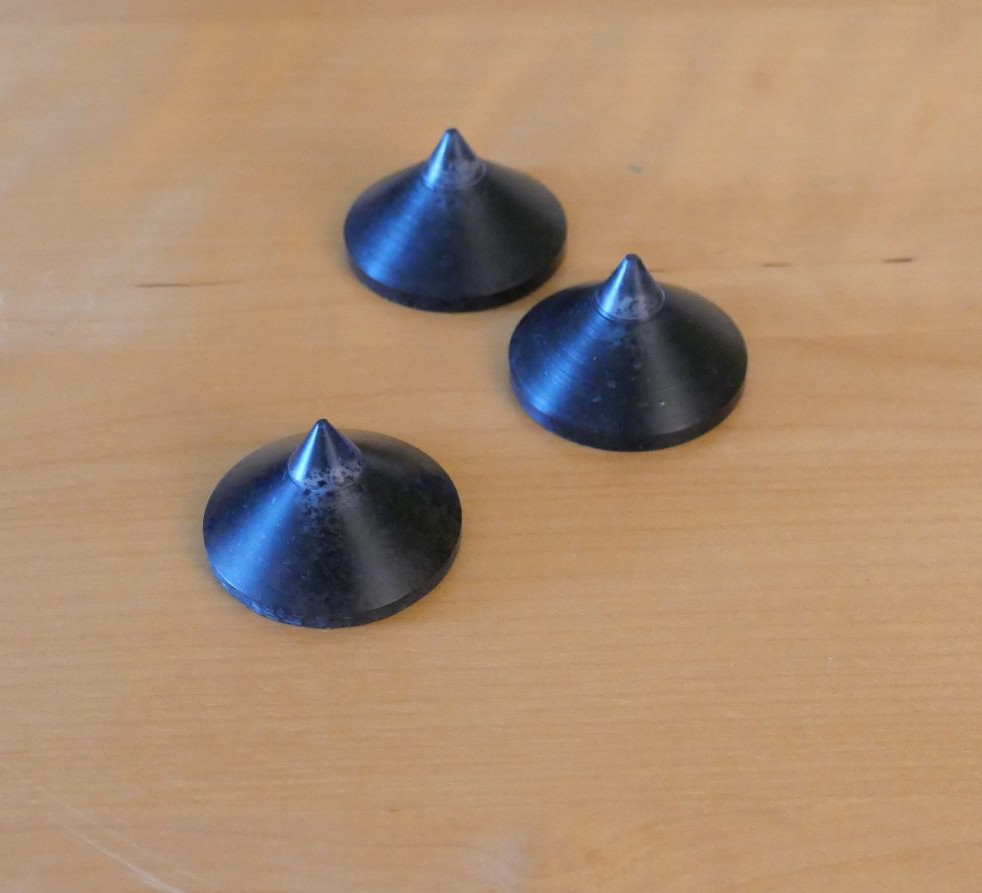
Talking of speakers, I got to use the 921 with a range of different speaker models, from the price appropriate (Spendor D9s and Living Voice Auditorium R25s) to the wildly inappropriate (the Peak Sinfonias). I also used Nordost Blue Heaven and V2 cables, along with Chord Music, although I have to say that the amplifier was essentially cable agnostic: the Nordost cables sounded like Nordost, the Chord like Chord and I wouldn’t anticipate any major matching issues. Pick a wire you like and stick with it. What’s less ambivalent is the amp’s response to questions of support and grounding. Having rung the changes with different footers and cones to by-pass the stock feet, the 921 expressed a solid preference for Acouplex cones over other, often more expensive, alternatives. Likewise, running a pair of ground cables from the RCAs on the fixed-level output to a CAD GC3 brought a significant improvement in transparency, depth, focus and dynamics. Neither tweak changed the nature of the amp. They just allowed it to sound more like itself.
So, how does the 921 sound? Fluid, engaging, unforced, self-effacing and, above all, present. Where many solid-state designs (especially more affordable ones) tend to a leaner, ‘faster’ and more obviously detailed sound in an effort to catch attention and sales, the Trilogy possesses both body and the dimensionality that goes with it. If there’s space on the recording, the 921 will preserve and reproduce it. What goes with that space is a purposeful impression of direction – a smooth and secure sense of musical pace and line. The Trilogy’s musical presentation is a little like the surface of a fast but shallow stream: you see the humps and bumps in the water, but nothing stops it and you can sense but not see the sharp edges of the rocks below. The Trilogy binds band-members together and directs orchestras, organizing and arranging their output with a natural, fluid vitality. There’s nothing jarring or jagged in this performance. There’s no doubt where it’s going or that everybody is going to arrive together.
So far, I’ve avoided discussing the obvious: the fact that previous Trilogy products have been almost invariably tube or hybrid in nature, involving thermionic devices to a greater or lesser extent, where the 921 eliminates them entirely. Yet a performance that’s smoothly fluid and rhythmically and dynamically coherent definitely possesses more than its share of tube-like tendencies. Throw in a mid-hall perspective and tonality along with a presentation that favours the holistic over the individual, spatial continuity over spot-lit separation and it’s clear that Trilogy’s shift in approach is technological rather than philosophical. Same goal, different route…
Whilst I don’t want to over-state the ‘tube-like’ quality, it certainly sets the 921 apart from most of the competition. But, assuming that’s at least part of the appeal for potential users, it also demands a degree of understanding on their part. The Trilogy is not alone in sounding better if you leave it on, but the difference you’ll hear after 48-hours is far bigger than you might expect – and that’s all to do with those tube-like tendencies. Fully warmed through, the 921 takes on an even more sinuous fluidity that brings added shape and continuity to phrases and musical lines. It gains depth and dimensionality. It gains harmonic resolution and a broader, richer tonal palette. Leave this thing on for a week, tucked away out of sight and even die-hard triode-lovers are going to struggle with the notion that they’re listening to (and loving) silicon-based signal transfer. It runs reassuringly warm and that too, I’m confident, adds to that tube-like continuity and character.