

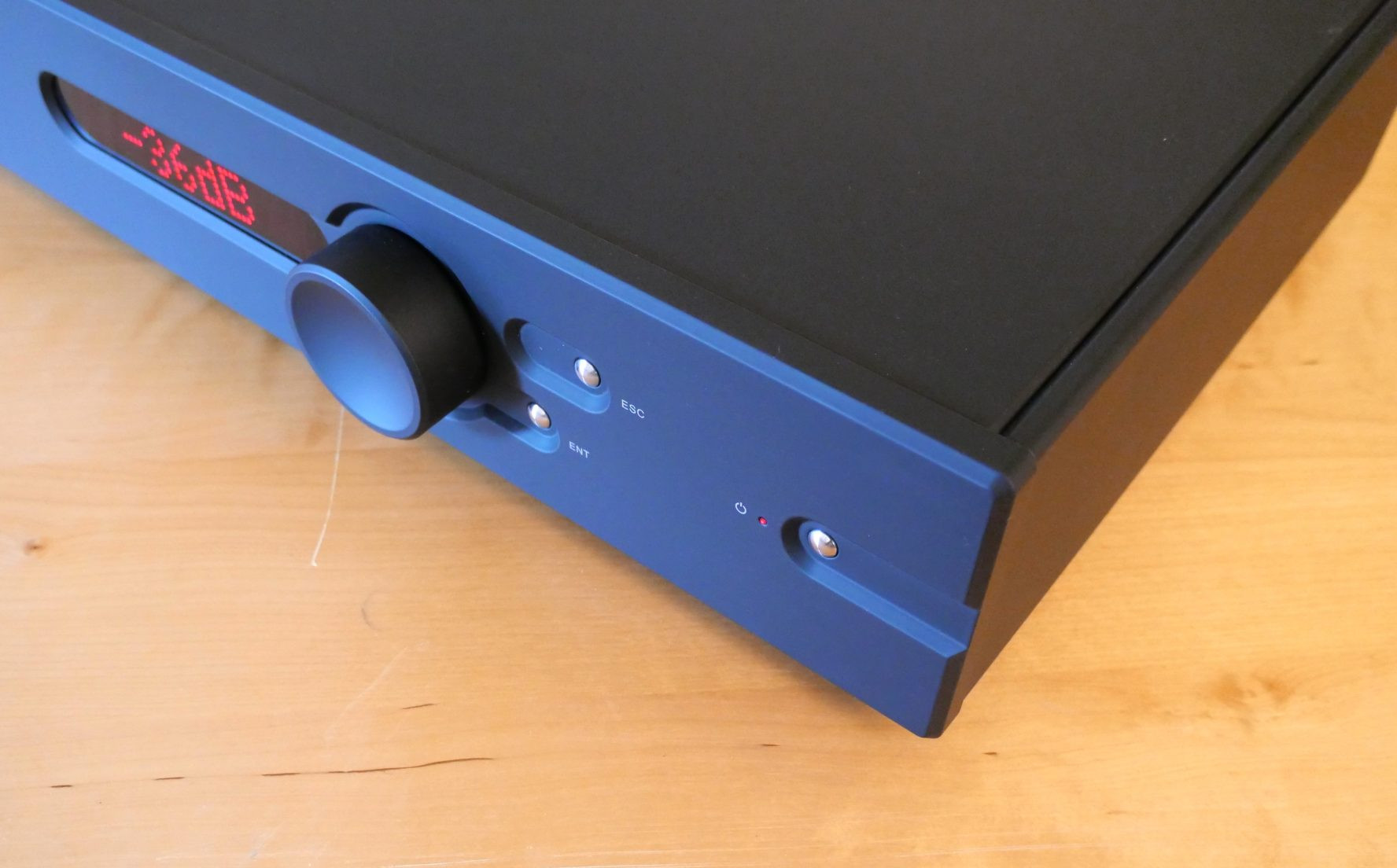
All that extra weight, shape and warmth will likely necessitate a small adjustment in speaker positioning. Having set the speakers after the 921 had been on for 24-hours I found myself re-setting them again, a few days later: a slight nudge in on the left and around 3mm forwards. If you find that your sound is getting lazy or flat, you’ll likely need to do the same. That small shift will restore the vitality and immediacy to the presentation – those other, most important, aspects of true tube performance.
How is all this reflected in the music you listen to? Take the Lisa Batiashvili recording of the Tchaikovsky Violin Concerto (Barenboim, Staatskapelle Berlin, DGG UHQ-MQACD UCCG-41048) as an example. It’s a brilliant performance because it manages to combine showcasing the individual, virtuoso playing of Batiashvili with the grand romantic sweep of the piece as a whole. It’s that rare situation where the soloist doesn’t just deliver, you can hear how she’s delivering – and how the orchestra respond to her lead. The Trilogy leans the presentation more to the piece as a whole, away from the intimacy and technique that’s there in the recording. I know it’s there because, the last electronics that played it through these speakers revealed and reveled in it. But then, that was a CH L1/X1/M1.1 combination, where even the external power supply costs more than twice the price of the Trilogy integrated! So, it’s not really surprising that the 921 can’t match the clarity, organization, resolution and intimacy of the CH kit. But what it does do is deliver the drama, pace, purpose, shifting densities and towering crescendos of this most dramatic ‘whole’. The way that it separates the timps underpinning the opening, pacing their slowly building power and momentum, the way it allows their detonations to punctuate the building crescendos throughout the first movement, isn’t just impressive, it’s what brings the performance to life. The shape and rumble of the percussion, separate to and driving the basses, propels the playing of the orchestra as a whole, supporting and jousting with Batiashvili’s swaggering lines. It’s all way more Heifetz than Hahn, but none the worse for it.
Turning to vinyl, played on the Kuzma Stabi M/4Point/and Etna Lambda SL, via the Connoisseur 4.2 PLE or Groove SRX phono-stages, the Trilogy loved the rhythmic integrity and confidence of quality record replay. The building power of Bowie’s ‘Station to Station’ (RCA Victor APL1 1327) is delivered with a grinding, crunching, unstoppable momentum, the vocals are ineffably cool, the life and energy of ‘TVC15’ propulsive and infectious. The ability of the 921 to preserve the pace, substance and purpose in a recording lies at the heart of what makes it so engaging to listen to. Interestingly, switching to the more measured playing and discipline of Víkingur Ólafsson’s Debussy-Rameau (DGG 028948 38283) the Trilogy retains that sense of shape and phrasing, pace and forward motion, albeit at the cost of the space between the notes. It’s not that those gaps aren’t there, just that they are less explicitly wrought than they can be. The body, volume and complexity of the instrument are beautifully captured, as is the sparkling vitality of the Rameau pieces. The Debussy lacks the depth and pathos that’s possible – but again, that’s measuring it against the highest standards. Back in the real world, the 921 leaves you in no doubt just what an insightful and captivating recording this is – or what makes Ólafsson such a different artist.