

Unlike the Linn or early Systemdeks, with their closed box plinths, the Revolution uses an open plinth design, the sub-chassis sitting within an open frame. The plinth itself consists of machined layers of Latvian birch ply, sandwiched between a 12mm top-plate and 6mm base-plate, both machined from a phenolic compressed paper/resin material called Richlite. Widely used in speaker cabinets, phenolic-based composites offer extreme rigidity and excellent self-damping. Used in conjunction with birch ply, the result is a stable structure that resists resonance and dissipates energy evenly. The stiff, 12mm top-plate offers a stable platform for the suspension springs, that hang in tension to support the sub-chassis, their adjusters accessible from above, something I’ll come back to in due course. The plinth stands on four Delrin cylinders which (praise the Lord) are height adjustable. Combined with the accessible suspension adjustment, they make set-up in situ a doddle, eliminating the need for special jigs or faffing around beneath the deck.
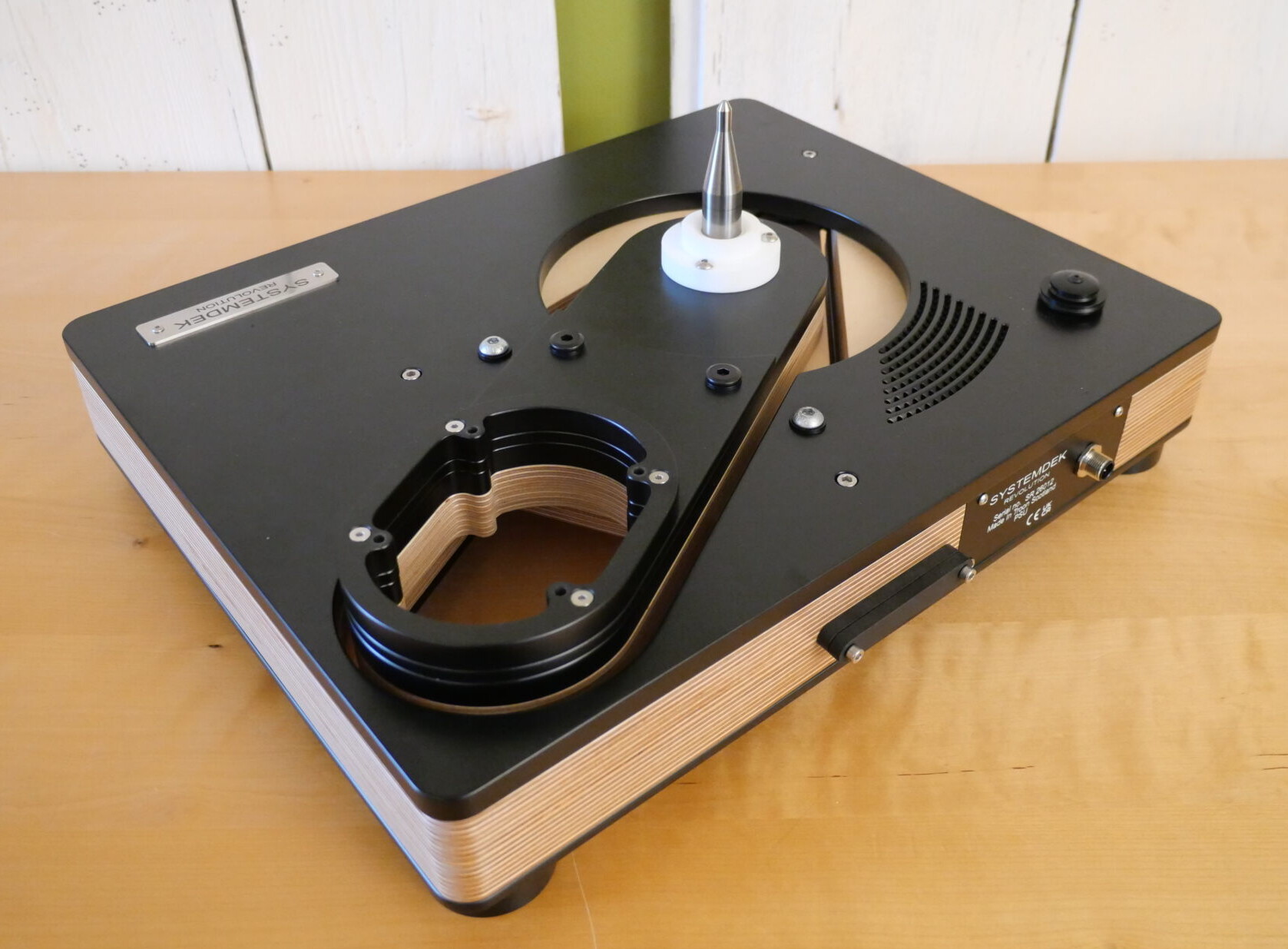
The upper surface of the sub-chassis, the upstand and removable/replaceable armboard, are all machined from Richlite, ensuring a precise relationship between the arm-mount and main bearing, the basis of geometrically accurate cartridge alignment. Flip the plinth over and the open underside reveals the elegance of the deck’s engineering, the multi-material construction of the sub-chassis mixing the thick, Richlite top-plate with a substantial, laminated wood ‘spine’ that accepts and reinforces the PTFE bearing housing. In turn, that sits on a triangular base plate, the corners of which carry the spring mounts. The total suspended mass is a sensible 5.5kg, in the same ball park as the likes of the Systemdek III and LP12, despite the absence of a metal platter. With the armboard’s long axis aligned with the platter spindle, the armboard will accommodate arms up to 10.5” in length, longer if they use an off-set mount, like the Kuzma 4Point or the Wand Dark Light tonearms. The plinth’s open base allows the arm-cable to exit and a simple clamp mounted on the rear of the deck allows it to be dressed so that it doesn’t impair the suspension.
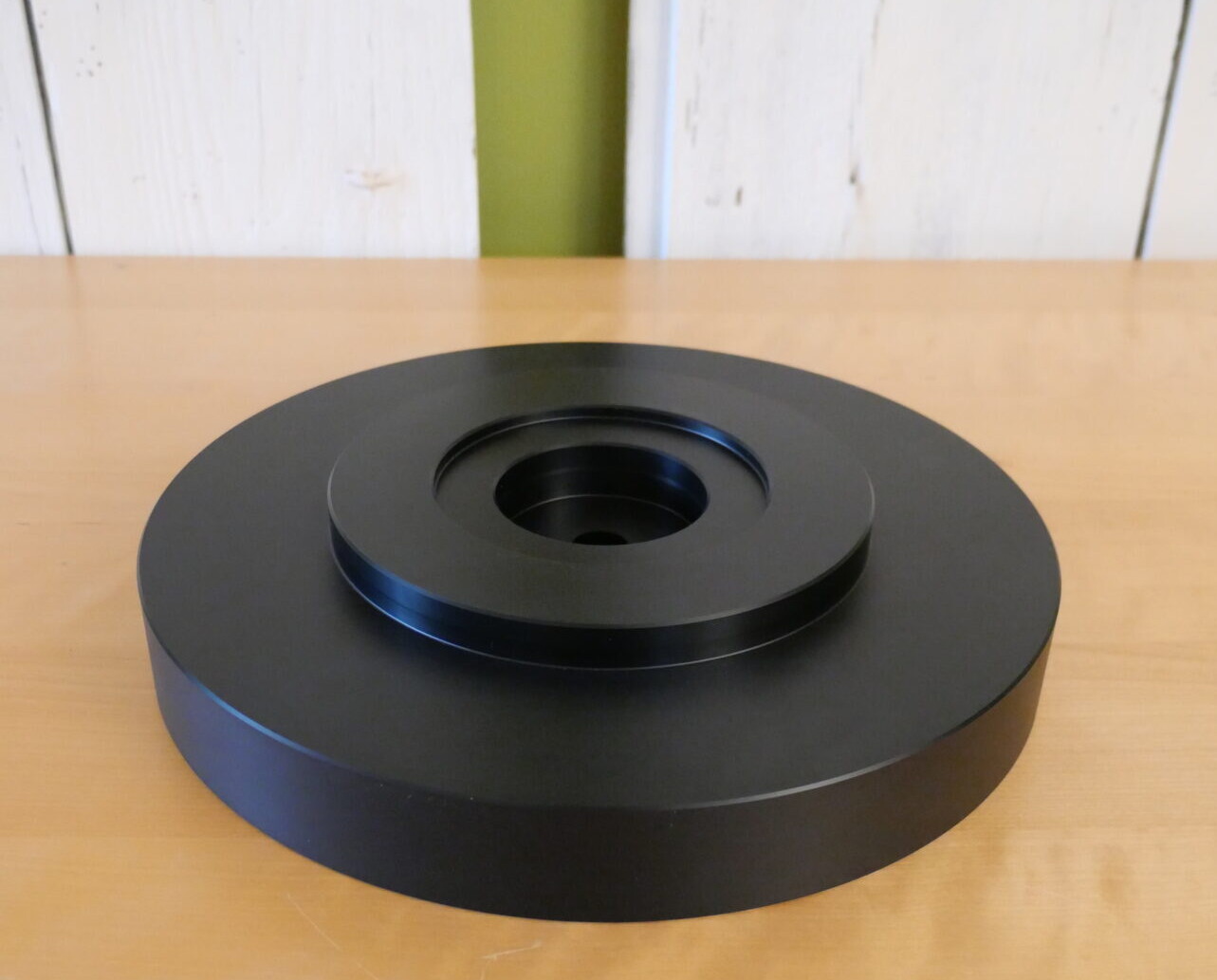
he platter’s one-piece construction eliminates the sub-platter which is so often used to act as the contact surface for the drive-belt. Instead, Systemdek has machined a deeper central section that extends below the platter’s underside to create the driving surface, allowing the motor pulley to sit outside the platter circumference to facilitate manual speed change for those without the optional external power supply. As with previous Systemdeks, the motor is a selected, low-speed, 24-pole, AC synchronous design. In standard form, this is fed directly from a wall socket via a rear-mounted IEC socket. Alternatively, users can opt for a more sophisticated external PSU. In either case, the incoming wave-form of the AC supply, or the one generated by the external supply provides a ‘locking frequency’ that fixes the motor’s rotational speed, a constant reference that’s absent in DC systems. Of course, that assumes that the wave-form being delivered is itself constant, which is far from a given and where the external supply comes in. Once again, Systemdek has done the smart thing and rather than designing their own supply they’ve gone to the specialists to source an excellent circuit that they’ve duly housed in a chassis that matches the Revolution’s plinth. The history of UK turntable design is littered with the wreckage of unreliable or sonically disastrous power supplies built by turntable manufacturers looking to cut corners (or suffering from hubris). It’s nice to see someone doing the sensible thing. A simple latched button switches between off, 33 (red LED) and 45 (red and green LEDs). There is no provision for user adjustment of speed, which is factory set. The external supply attaches to the deck via a small, multi-pin connector with a secure screw collar. What that means is that a standard deck that plugs straight into the wall cannot be field upgraded to the external supply, although it can be factory modified.