

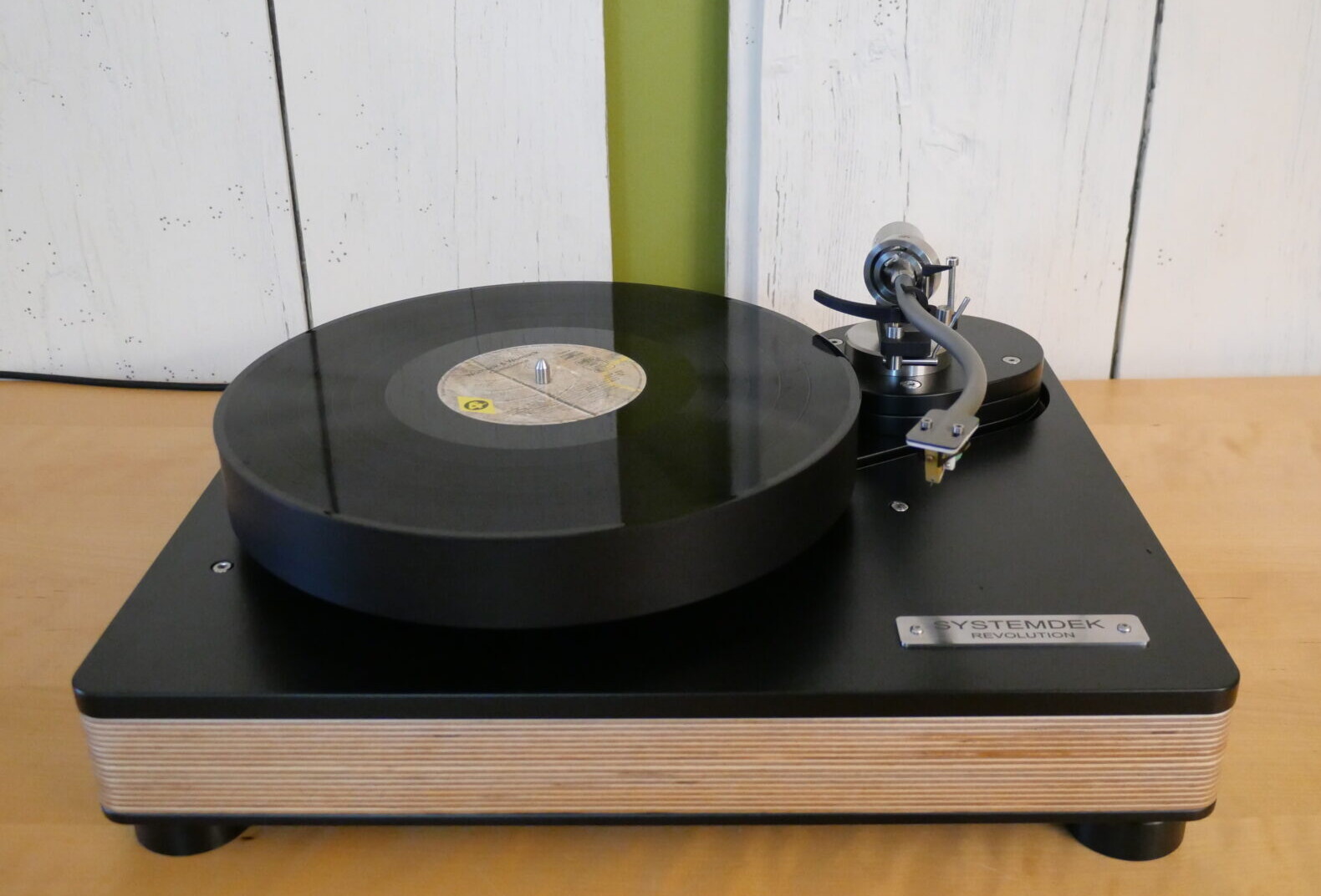
That ability to maintain the musical balance and sense of proportion within the recording, founded on its even spectral linearity, spatial and temporal stability translates directly to larger, more complex and more demanding works. The recent re-issue of the Colin Davis/Boston Symphony recordings of Sibelius’s Symphonies 5 and 7 (Philips 6500 959/Decca Pure Analogue 487 1495) is perhaps the perfect example. The sporadic scoring draws from seemingly random elements within the orchestra, a note here, a phrase there – yet successfully combined they create a sense of musical momentum and stepped, swelled orchestral power that’s hard to find in any other composer’s work. The challenge is to bring temporal discipline and dynamic control to those disparate elements, binding them into a single, comprehensible whole. It’s a challenge for both orchestra and conductor, one that Davis rises to magnificently – ably helped by the Boston’s legendary brass.
From the deceptive simplicity of the short, repeated pizzicato phrase that opens the Second Movement, echoed in the woodwinds, the composer builds a burgeoning musical flow that transitions into swelling, bowed strings, growing in pace, density and power, drawing the brass into a rising finale before the calm of the resolution. The Revolution masters the shifting, evolving scale, complexity and intensity of the piece with a relaxed but secure grip so that as it moves into the final movement, the swelling power and dynamic punctuation grow naturally out of the preceding parts. The pattern behind the music and the purpose within the performance are never in question. The sense of musical direction and impetus is as natural as it is compelling, driven by the orchestra and the conductor, rather than the sound itself.
That refusal to exaggerate or play to unrealistic expectations puts the Revolution in a very good and very even-handed place when it comes to traversing different musical genres. It’s sense of proportion allows it to track musical density, while shifts in emphasis add power, both musically and emotionally.
A deck for all seasons…
Although I’ve concentrated thus far on classical recordings, that’s because those both challenge the broad performance envelope and explain the Systemdek’s strengths. But those strengths play just as strongly, if less obviously, with other music. ‘Boys Don’t Cry’ (from The Cure, Acoustic Hits – Polydor 572634-0) starts with the crisp click of drum sticks counting the band into the track’s opening chord sequence and infectiously insistent melody. Despite its relaxed sense of control, there’s no lack of pace, drive or urgency here. The propulsive rhythm is measured out with precision and purpose, the almost jaunty, up-beat feel of the music, its contrast to the bitter-sweet lyric is more clearly apparent than ever before. Is Smith in better voice now then back in the ‘80s? Is it just the more intimate vocal and an increased focus on it within the recording? Either way, the Systemdek gives you a new perspective on both the song and the singer, the character of Smith’s voice, his vocal inflexions and the way he shapes his words to add emotional intent. It underlines just what a clever lyricist he is and echoes the often -overlooked subtlety in his guitar work. This is an extraordinary level of musical insight for a deck at this price. That it’s achieved in combination with the affordably priced Origin Live Zephyr tonearm makes it even more extraordinary.