
A lot of this is down to low-level acoustic and harmonic information – which is, in turn down to the absence of grain and tonal compression. Insidious noise, generally generated by the main-bearing and any motor breakthrough can obscure these low-level spatial and tonal cues below a mist-like blanket. Just like mist, it robs the land/soundscape of detail, distance and colour. Changes in bearing design, such as the introduction of PTFE thrust pads, magnetically opposed, or reduced down-force designs have all countered this problem, but like everything-else in audio, they also bring their own compromises. In the case of magnetically opposed bearings, the ‘spring’ at the bottom of the shaft can lead to cyclic height variation in the platter as well as creating a break in the ground-path from the platter surface itself. Systemdek has been unusually successful in countering these issues. I suspect that the large diameter bearing shaft, hydro-static design and substantial platter mass combine to provide an unusually stable and dispersive platform for the record. Whether that’s the case or not, there’s no denying that the Systemdek offers a remarkably constant musical perspective and proportions. There’s no tendency to wander and instruments don’t shift in the stage as their pitch or level changes, with no climbing or piling forward to disturb the view.
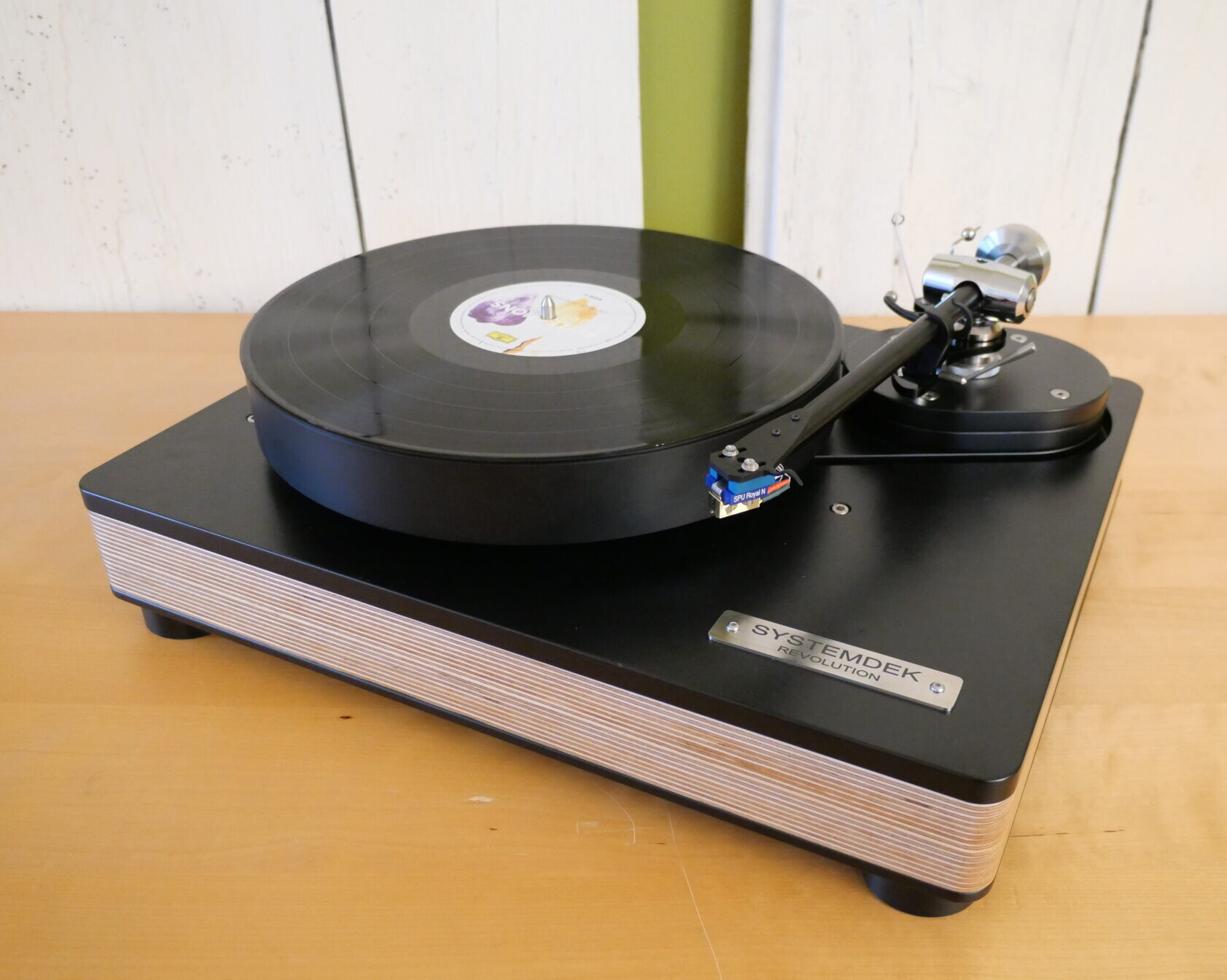
alking of stability, the other great contributor is a rock like constancy to the ‘table’s rotational speed. Play Víkingur Ólafsson’s Debussy-Rameau (DGG 4838283) with its combination of considered, sustained decay and rapid, quicksilver sprays of notes and there’s no wavering in the pitch, no blurring or confusion in the rhythm, spacing and shape of those fleet-footed phrases. The Revolution might not match the leading-edge precision and attack of hard-coupled turntable designs, but it’s remarkably even across the range. Just as the soundstage is naturally proportioned, so too are the dynamics. Take Krystian Zimmerman’s recent Beethoven cycle (with Rattle and the LSO as an example – DGG 289 483 9975) as an interesting example. A covid recording, made with a socially distanced orchestra which tempers Rattle’s bombastic tendencies, ‘tables that lean on the front of the notes exaggerate the impact of the orchestral interjections, making them clumsy and distracting. The Systemdek offers a more measured delivery, in which weight comes back into balance with impact – a presentation that is more natural and more musically effective. Interestingly, in spectral terms, it’s far closer to the more linear delivery of really good CD – but combined with the substance, dimensionality and presence that goes with great record replay.
If you want to really hear those qualities – the absence of grain, the absolute stability and sense of balance and proportion – reach for something delicate and fragile. Mari Samuelsen’s Lys (DGG 486 2095) is the perfect example, her delicately precise lines with their elongated phrases poised against a muted accompaniment. Any imbalance in the weighting of notes or instruments will stand out like a sore thumb, but the Systemdek captures the ephemeral beauty of the music and the playing perfectly. With the Revolution, Samuelsen’s tone has a purity, her playing a poise, that hold the centre of the music and the recording – just as they do live. Whether it’s the perfect balance of swelling strings behind ‘White Flowers Take Their Bath’ or the sparse accompaniment to the surprising inclusion of ‘Halo’, there’s a rightness to the weight of instruments, a natural balance between them. Lys is an album of subtle reflection and deftly combined textures that the Revolution serves perfectly, recreating music that’s as atmospheric as it is captivating.