

All of a sudden, the review becomes a far more complex proposition, with wider reaching implications and more questions to answer. The Reference Transport might be the harbinger of change, but that means looking at both its thinking and performance and the alternatives, optical and otherwise. So, consider this Part 1 of a wider reaching project. A first ‘chapter’ that considers the Reference Transport in the context of the wider Wadax range and the company’s own alternative digital solutions. Part 2 of THIS process will then look at how the Reference Transport compares to and differs from the competition, both digital and analogue. Just be aware that there’ll be several, necessary steps in between…
One Step Beyond…
Take the time to look at the Reference Transport in detail and it soon becomes apparent that, if you ignore financial constraint, the challenges and compromises inherent in most optical disc replay systems become clearer and easier to compartmentalise – at least in conceptual terms. You can break the problem down into discrete parts or elements. But first it’s necessary to understand the problem itself.
In many ways, the challenge of optical disc replay is essentially similar to record replay. You have a spinning disc and a measurement system designed to extract the information stored on that disc. In the case of the record, the information is stored and measured mechanically, the arm and cartridge ‘reading’ the data as vibrations within the cartridge’s magnetic circuit. That makes the reading process directly impacted by spurious vibration that might be read as signal. On the surface, the zero contact reading technology of optical disc should eliminate this problem. In practice, vibrations in the discs and the laser mechanism itself still impact the resulting read data. The degree might differ, but the problem is essentially the same.
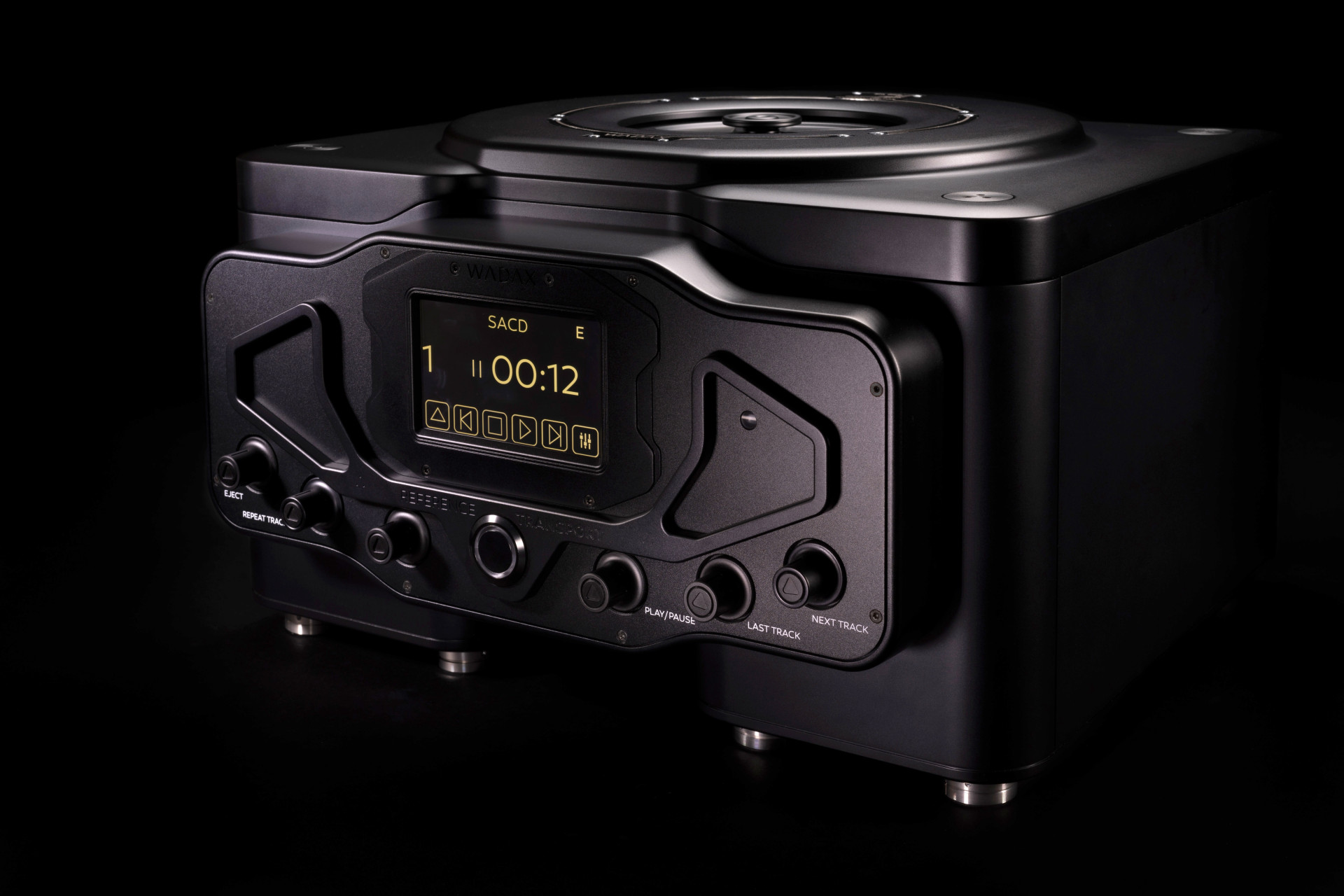
Likewise, as Ivor Tiefbrun famously said, all a turntable has to do is spin quietly and do it at a constant speed. The size and weight of the disc, its coupling to the platter and the requirement for speed stability make this a considerably easier task than that confronting an optical transport. The low-mass of optical discs and the fact that the transport has to spin them not only fast (CDs spin at between 200 and 500RPM, SACDs spin around three times faster than that – up to 1,467 RPM!) but to vary their speed precisely depending on the point across the read surface, mean that the actual operation of spinning the disc is far more complex. Throw in the fact that the disc itself is essentially unsupported and free to vibrate or oscillate and you’ve got a mechanical nightmare on your hands.* The more mechanical errors or electrical artefacts you can eliminate, be they the result of external vibration, vibration generated by the disc itself, speed or tracing errors introduced by geometrical inaccuracies in the disc or electrical noise generated by speed or correction circuitry, the better off you are going to be.