

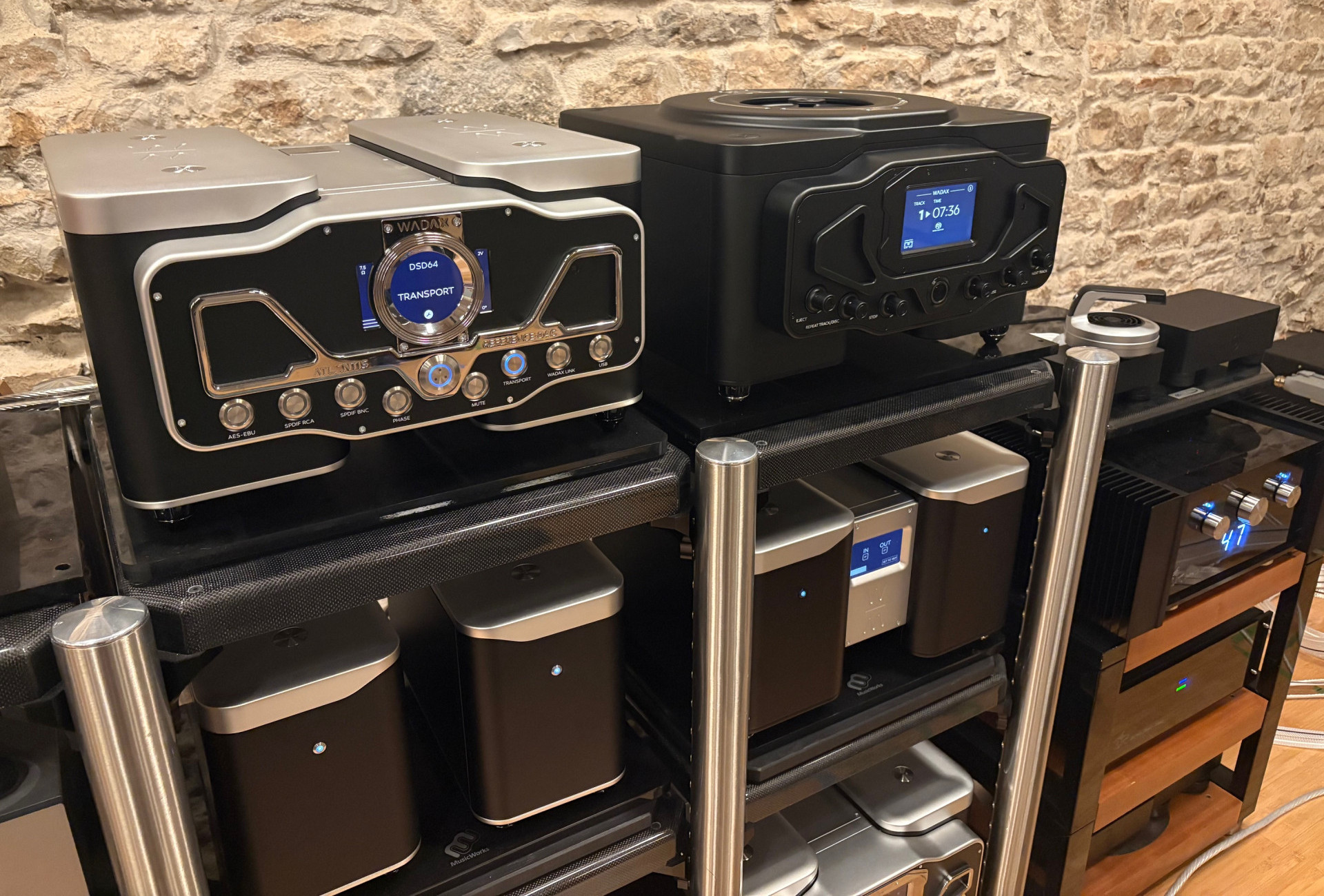
The machine is supplied with one of Wadax’s slim remote controls that covers all the basic transport functions and a direct access key-pad for cutting straight to a desired track. Don’t get confused by the presence of Volume buttons: that function isn’t applicable to the Transport. The large LCD display is however, extremely legible, even at distance, while jumping tracks gives you an even bigger track number, against a clear screen: clean, clear and very sensible. You can vary display brightness and access machine status information via the touch screen.
The Reference Transport replaced the Atlantis Transport in a system consisting of the Ref DAC, CH Precision L10 and M1.1s, driving various different speakers. It has been in-house for some time while I both got to grips with it and cleared the decks of other review projects. That gave me the chance to use it with the remarkable ASR Emitter II Exclusiv ‘integrated’ amplifier, the VTL S-400 II and the Kora CSA-1200 amplifiers, as well as both planar and box speakers. All of which served to reinforce the Reference Transport’s consistent character and qualities.
We have touch down…
It’s not exactly spilling the beans to reveal that the Reference Transport is something different and special. That is, after all, the Wadax way. But what matters is, how it’s different, how that difference manifests itself musically and, whether or not it matters? While I could discuss the Reference Transport’s performance in the abstract – and do so at some length – it makes more sense to use the musical way markers that Wadax themselves provide: the Studio Player, the Atlantis Transport (that performs disc replay duties in more than a few Wadax-based systems), the option of the Reference Power Supply and, of course, the Reference Server. I’ll report on those comparisons in turn, starting with the young upstart…
Initially at least, these will be straight comparisons, stacking up the existing products or options against the Reference Transport connected to the Reference DAC via the Dual Akasa optical input module, as this is the mode in which most users will employ the components, either with or without the external PSU option on the Transport. That I’ll leave for separate consideration, for obvious reasons. All of the Wadax units in these listening comparisons were fitted with four RevOpod feet, for all the reasons cited above. They also constitute (quite literally) a level playing field, making placing and optimizing the various pieces both quick and simple: no small thing with individual units that weigh as much as the Wadax components do.
Comparison One – The Studio Player
The Wadax Studio Player was possibly one of audio’s most keenly anticipated products. Riding on the reputation of the Reference DAC (and using the same DAC cards) it promised more than just a taste of the flagship product for a fraction of the price, while throwing in a CD/SACD transport and self-contained streaming capability. Nor did it disappoint. The Studio Player was instantly recognisable as a Wadax, with the same immediacy, musical literacy, sense of shape and performance as the Reference components. It made for a versatile, engaging and satisfying musical source, as comfortably sitting alongside high-end analogue front-ends as it is replacing far more costly digital alternatives. In fact, so impressive is the Studio Player that there are those who suggest it eclipses (or at least undermines) the Reference components. The proof of that pudding is in the listening and as much as I’d love it if you could buy Reference performance for Studio money, sadly it isn’t so…