

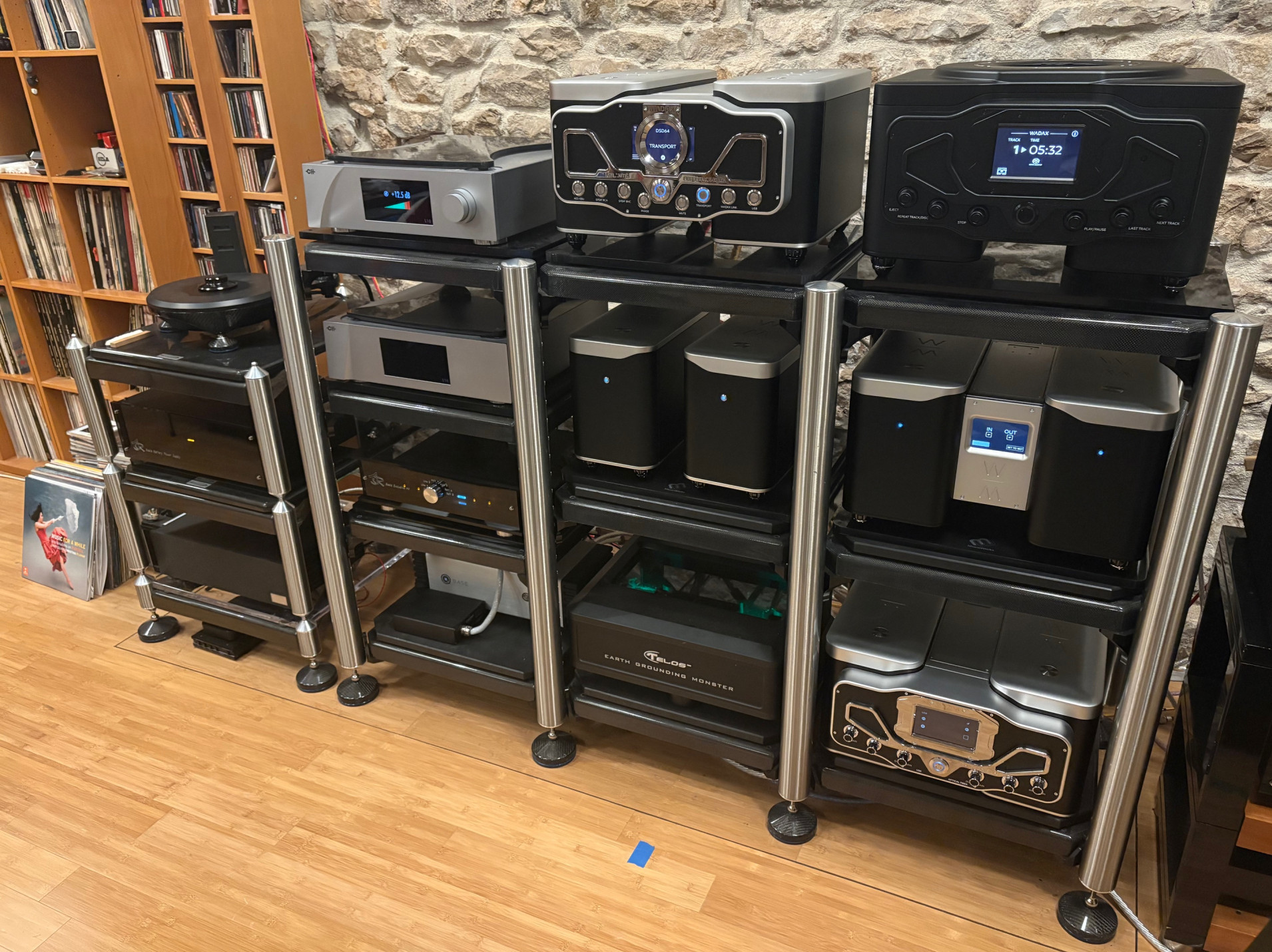
The other thing I really like about the RevOpods is just how precisely you can adjust level and individual loading. The soft detents in their height adjusters means that throughout levelling (or, once level) it’s easy to make small, completely repeatable adjustments. That’s important not just for ease of use, but because past experience shows that the compliance built into the RevOpods can be ‘tuned’, depending on the weight of the supported unit and, once level, where you set the feet in terms of their distance through their vertical travel – a little like deciding how much thread to leave visible when setting spikes. Further experimentation with the Reference Transport showed that adjusting the height of the unit in this way produced clearly audible results. A few clicks up or down on all four feet produced clear shifts in the balance and presentation. As low as possible, while still floating, noticeably improved the sound, adding stability, body and dimensionality to the performance, without impairing the musical flow and communication.
I sat the Transport on an Acouplex support shelf, instead of (and in preference to) the stock bamboo shelf that comes with the Monza. I also tried the Transport on the six-footed HRS M3X platform I have for the Kuzma Stabi M, but this proved less than successful for the purely practical reason that the RevOpods smooth feet slid too easily on the slick surface, shifting the centre of mass on the flexible feet of the platform and upsetting the Transport’s level. The Vortex footers might offer a solution, but levelling would be a bear! I ended up reverting to the Monza/Acouplex combination.
Data transfer was via the Akasa Optical interface, requiring the installation of the dual-input module in the Ref DAC, along with a remote software upgrade. I suppose that I could have tried the Wadax transport in combination with the CH Precision C1.2, but that would have meant using the AES/EBU or S/PDIF connection, an arrangement that would compromise both products. Just as the Wadax is built around the Akasa connection, the CH units all use their own, proprietary HD-Link. Even dCS uses its own ACTUS cable interface, although running clock, control and digital signal down a single cable seems more like a suicide pact than a step forward in audio performance. But what is undeniable is that despite a growing number of boxes, high-end digital systems are becoming more intimately integrated, whether that’s for engineering reasons or marketing convenience. So, in order to make direct comparisons, it’s necessary to wait until we can put complete replay chains next to each other – something that is already scheduled, at least in the case of Wadax and CH Precision.
Operationally, the Reference Transport is essentially straight-forward. The same rotary/push buttons that Wadax uses on the Reference Server control transport operations, with six separate controls for Load/Eject, Repeat, Stop, Play, Previous/Skip Back and Next/Skip Forwards flanking a central power button. Once again, the website is misleading, the prototype unit used for photography showing transport controls on the central touch-screen – a carry-over from the Atlantis. They’re not there on the Reference. Loading is reasonably quick, given the complexity of the iris closure, but in common with other multi-standard machines, it does take a while to read the disc. Place the unit too high and the angle of view might make locating the manual clamp a bit hit and miss. It’s really only a question of practice, but along with the unit’s weight, it’s another argument for a lower-level placement.