

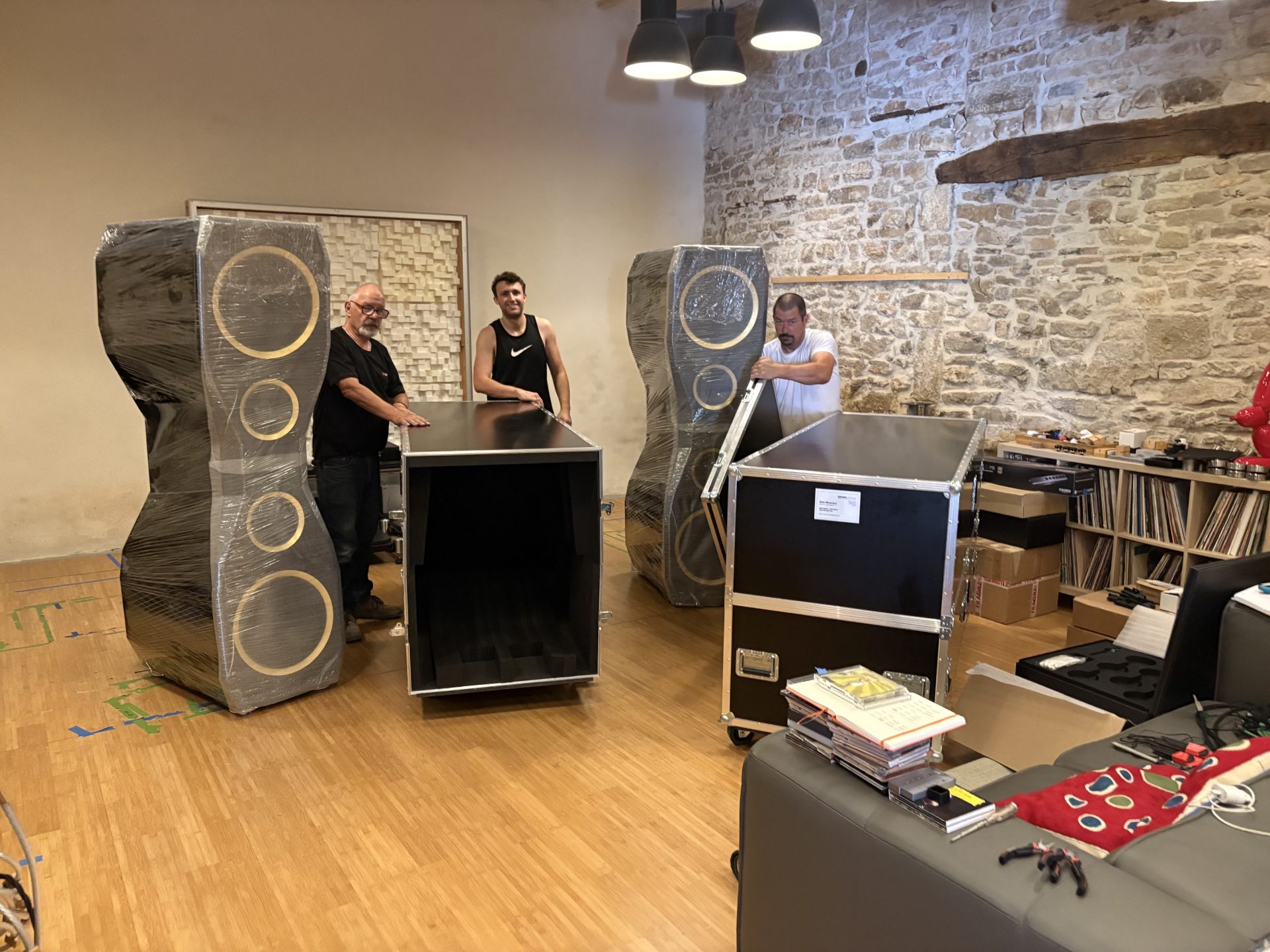
End result: the lorry carrying the speakers arrived at 10:15AM. The speakers were unpacked and placed in less than an hour. But the one thing that, short of making the flight-cases completely collapsible, you can’t do anything about, is their size. If the speakers are big, the packaging is necessarily even bigger. That presents a long-term storage question, but it also creates a practical issue during installation. Getting the speakers vertical and removing their cases needs space: space for people to get around and a hold of the cases (massively helped by the handles); space to remove and deal with the flight-cases once they’re off the speakers. That means clearing the floor and, in turn, that means positioning the speakers and clearing the decks before the amplifiers can be brought in and placed. Fortunately, once again, many hands made light work – or as light as a pair of M10s can ever be…
Hidden pieces…
The speakers and the power amps are only one part of this jigsaw puzzle. As already noted, the digital front-ends amount to a considerable number (and weight) of boxes – and present their own challenges – not least the fact that it makes most sense to get them installed and out of the way before the speakers even arrive (components are a whole lot bigger in their shipping cartons). Firstly, there’s the issue of accommodating them. Then you have to wire them all up. If you want to achieve meaningful results or product assessments, either in isolation or comparison, that means careful execution and consistency. Start placing components on different supports, feeding them with different power cables (or even, different length power cables) or different ground paths and the variables start to multiply exponentially. Pretty soon you are not sure what you are listening to or why it sounds different. The more complex the system and the greater the number of components, the bigger the challenge.
The first issue with any project this complex is with equipment support and providing enough of it without impacting component performance. I have 10 shelves and two amp-stands of Grand Prix Audio Monza and three shelves of Monaco (normally used for the Monaco turntable). I have substituted Acouplex shelves throughout, combined with the carbon-fibre frames and appropriate damping rings. I started by tightening all of the bolts that connect the components in the Monza rack, checking the level of both the Monza and Monaco frames and adjusting and locking the ball joints that interface with the Apex XL feet.
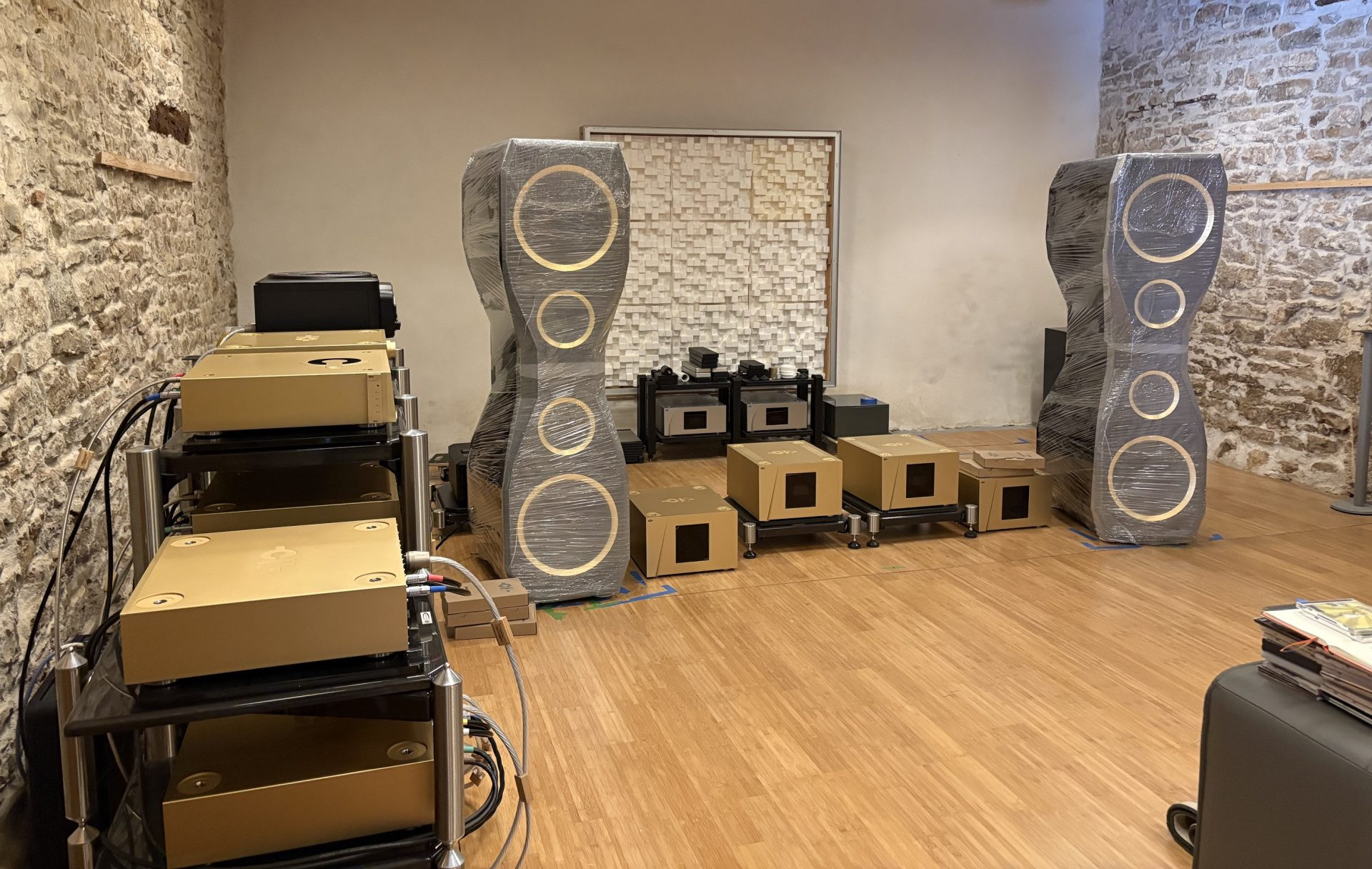
Next step was to allocate shelf-space by component and check that the weight-rating on the dampers was correct in each case. The initial set-up involves seven CH components (D10, C10, T10 and L10) and five Wadax pieces (transport, DAC, three power supplies) but only four shelves as the Ref DAC’s PSUs can share. That’s a grand total of 11 shelves, leaving one for the front-end power distribution and one spare. I kept all audio components on the Monza rack, using the Monaco to support the C10/D10 power supplies. The CH pieces were spiked directly to the Acouplex shelves, using their internal mechanical grounding/leveling spikes. In each case, the component was carefully leveled and the loading on all four spikes equalized. New CopaSlip was added to the threads of the titanium spikes, to ease adjustment and prevent galling.