

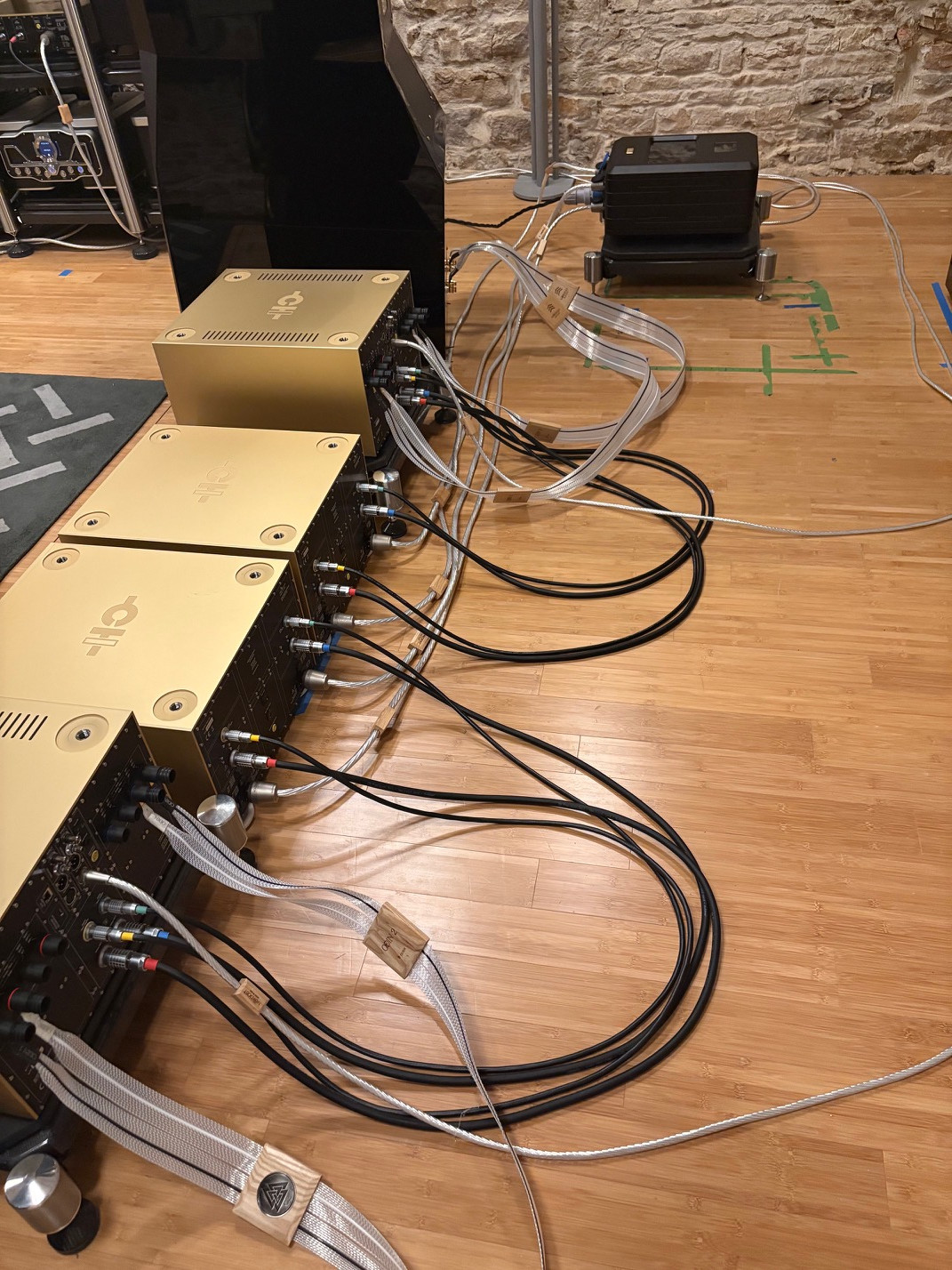
With two power cords feeding each amplifier power supply, four umbilicals between each power supply and its audio chassis and two speaker leads from each amp to each speaker, there’s a lot of cables to consider and dress. Fortunately, the configurable nature of the M10’s inputs and output mean that each amplifier only requires a single interconnect, despite running two separate channels. While symmetry suggests placing the Telos Tai-Chi power unit between the amplifier pairs, cable dressing actually favours placing it off to one side so that the four 20A power cords can run laterally, close behind the amplifiers, allowing all the other cables to cross them vertically spaced and at right angles. It also allows maximum latitude in terms of sideways movement of the speakers. With the power cords connected and dressed, it was just a case of hooking up all of the umbilicals and signal cables, laying them in the correct patterns – and making sure not to reverse phase on any of the speaker connections. That’s easier than you might think, given that CH denote +/- using red/black and blue/black terminals (to facilitate bridged connection), the Göbel speakers use red for positive and white for negative and the Odin 2 cables white for positive and black for negative! Colour match and it’s easy to wind up with a positive cable connected to a negative speaker terminal…
With only two amp stands and four amplifier chassis to accommodate, the other major decision to be made was whether to use the amp-stands under the audio units or the power supplies. It might seem like an obvious choice, but bear in mind that the power supply chassis generate a lot more mechanical energy from their huge, paired transformers and that they’re strapped to the audio chassis by metal strands that transmit that energy almost as efficiently as they do electrical current. I actually tried it both ways and opted to place the audio units on the stands, but to support all of the amplifier chassis on Acouplex (shelves on the stands, pucks under the PSUs) and use HRS damping plates on the power supplies. As well as sonic benefits, raising the outer units while running the power cables to the central ones also offered advantages in terms of cable dressing. All of the other CH units were equipped with Acouplex ReFract panels, including the larger footprint version developed for the deeper, M10 casework.
Final part of the power amp puzzle was to locate the CAD GCR for grounding purposes. This was located off to one side, opposite the Telos Tai-Chi AC distribution unit, but not quite as wide, limited by the desire to keep all of the ground wires the same length. What isn’t immediately apparent, especially to those familiar with the smaller Noblesse model, is that the Monarque speakers use a composite cabinet construction, that employs substantial aluminium baffles, akin to those used on the flagship Majestic. There’s also a massive, machined cover that fits into the ‘elbow’ in the cabinet rear. I’d love to hear what happens if you electrically connect those baffles together and then supply a ground point so that they can be hooked up to an external ground. The benefits of doing this with speakers like Magicos and Stenheims (with all aluminium cabinets) are widely reported. With no visible fixings, the baffles will have to wait, but I will play with the rear cover plates to see what happens. But, like grounding, cable risers and other niceties, that will have to wait until speaker positioning has been optimized – and that will need to wait for Stirling Trayle to arrive.