
I have removed the supplied feet and (rattly) captive footers from the Wadax components. Use the cone feet if you must, but ditch the drum-shaped covers. It’s remarkable how often you see the Wadax units at shows or in systems where they are still using the supplied feet/footers, when replacing them is such an easy and musically obvious upgrade. In their place I use Arya Audio RevOpods, four (not eight) to each unit. The components need to be levelled and then their height set within the available range of adjustment. Tedious it might be but this makes a really audible difference to spectral balance, flow and rhythmic continuity. The RevOpods are a common upgrade amongst Wadax owners and it’s not hard to hear why. I’ve recently started to experiment with the Stack Audio Auva feet and initial results suggest these might also be a viable alternative – albeit one without the RevOpods’ incredibly precise (but frustrating) leveling function. Whether they’ll maintain level without the use of locking nuts, only time will tell…
Shouldn’t we be using identical supports under each and every component? The objective here is to optimize performance, rather than eliminating points of difference. A consistent approach to support and the dissipation of mechanical energy is essential to a coherent musical result. But within component eco-systems, the interface with that support can be further optimized to bring the best out of each front-end. I could use the RevOpods on the CH components (and some listeners do) but I have tended to prefer the black rods supplied with the 10 Series, at least in conjunction with the Acouplex or bamboo shelves I tend to use. Shift to a harder, more reflective surface, like the granite top of the HRS M3X2 platform, and I can see that that preference might well change, the lossy interface of the RevOpod possibly coming into its own. Likewise, the Wadax units are structurally distinct and far heavier than the CH pieces, which helps explain the move away from a hard-coupled solution. It’s yet another example of the necessity of thinking in global/system terms, rather than taking and working with components individually.
Despite the number of individual components in the various iterations of this system/set-up, we’re fortunate in two regards. The core electronic components come from just two companies and, both companies take mechanical grounding of their components seriously and have each developed a consistent approach to it, which means the support and interface permutations are significantly reduced.
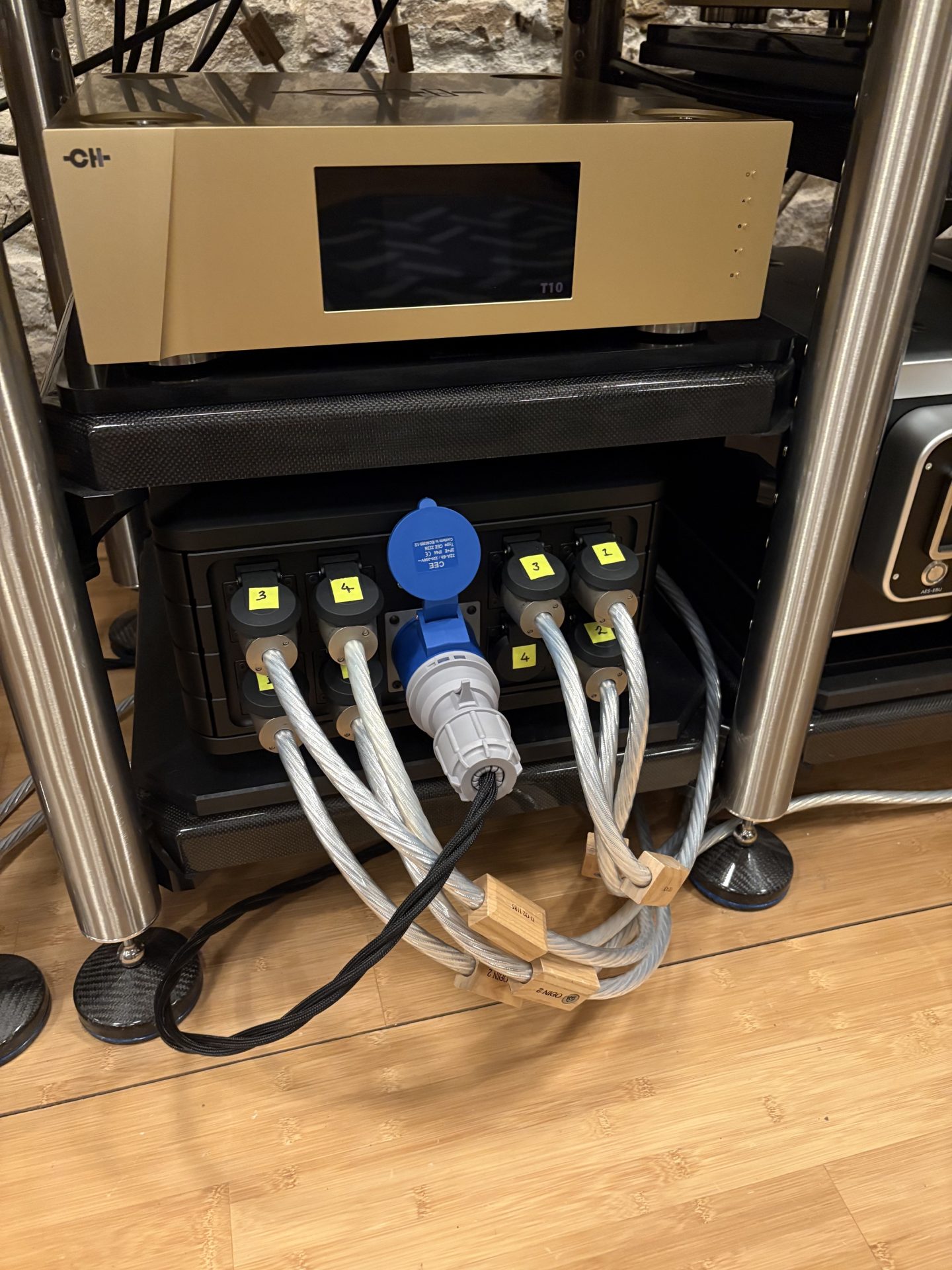
When it comes to AC distribution, the whole system is being run from a Telos Power Station Tai-Chi Edition, twin chassis, PFC power supply, connected to the Music Room’s dedicated AC supply and grounding set-up. This substantial and sophisticated AC solution will be reviewed shortly, but in the time that they have been here, both the standard Power Station and the Tai-Chi Edition have become invaluable contributors to the reviewing process. Despite the low loading demands on our AC supply – one benefit of a semi-rural, non-industrial location – both Telos units bring a substantial increase in consistency to the sound of review systems, alongside their dynamic and noise related benefits. The Tai-Chi dedicates one chassis to the front-end components, the second to the power amps, with each offering eight outlets. In this case, with the system running two front ends at any one time, that’s just enough! The standard Power Station offers a single chassis format with eight sockets, which is enough for most system demands. Half the size, it’s also half the price, both things being welcome.