

Manufacturer
CH Precision Sàrl
ZI Le Trési 6B
1028 Préverenges
Switzerland
www.ch-precision.com
Post Script
No flagship, high-end or simply expensive digital source component or DAC can escape the deep shadow of the Wadax Reference system. Since the arrival of the massive, massively expensive and divisively styled Wadax Reference DAC, its sheer musicality has blown away all comers. Expensive competitors have arrived – and duly been banished in ignominy…
Until now.
CH Precision’s 10 Series digital components are the first I’ve heard that genuinely challenge the Wadax hegemony, encroaching on what the Wadax does so spectacularly well, going so far as to suggest where it doesn’t come up to the mark.
The Wadax represented a substantial advance in the state-of-the-art when it comes to digital replay, a step forward so large that it left the competition scrabbling in its wake, clutching the fig-leaf of lower pricing as protection. The 10 Series components are the first to confront the Wadax head-on in terms of musical performance, integrity and authority – and to do it on their own terms, as a result of their own developmental path. Yet, perhaps not surprisingly, if the technology and hardware employed in the two different systems are distinct, there are also a number of clear similarities in approach and priorities.
- Both employ unique and genuinely innovative DAC topologies.
- Both use a massively engineered and mechanically grounded, top-loading disc transport.
- Both stress the primacy and separation of PSUs.
- Both go to considerable lengths to isolate DC feeds (analogue and digital) clock signals, control signals and the audio signal meaning that in each and every case, there’s no compromises when it comes to cable lengths, cable type or connectors.
- Both carefully manage and isolate the transfer of audio data, going so far as to develop proprietary transfer protocols and hardware – and apply that proprietary approach to both optical and file sources.
For many readers (and many of us can afford neither system) the million-dollar question is, how does the CH 10 Series compare to the Wadax? Well, that’s the ultimate goal of this convoluted exercise – a review process that started with the arrival of the Wadax Reference Transport. But to answer that question, we first need to upgrade the 10 Series to its ultimate form, assessing what benefits another three boxes bring to the party. Then we have to set the Wadax and the 10 Series up in a single system, just as carefully as we set up the comparison between the 10 Series and the 1 Series. Then we have to ring the changes in that system, to check and verify the consistency of the results. None of that is quick or easy, so don’t hold your breath waiting for the results. They won’t be arriving next week – or even next month. If it’s worth doing, it’s worth doing right and that’s going to take a little while.
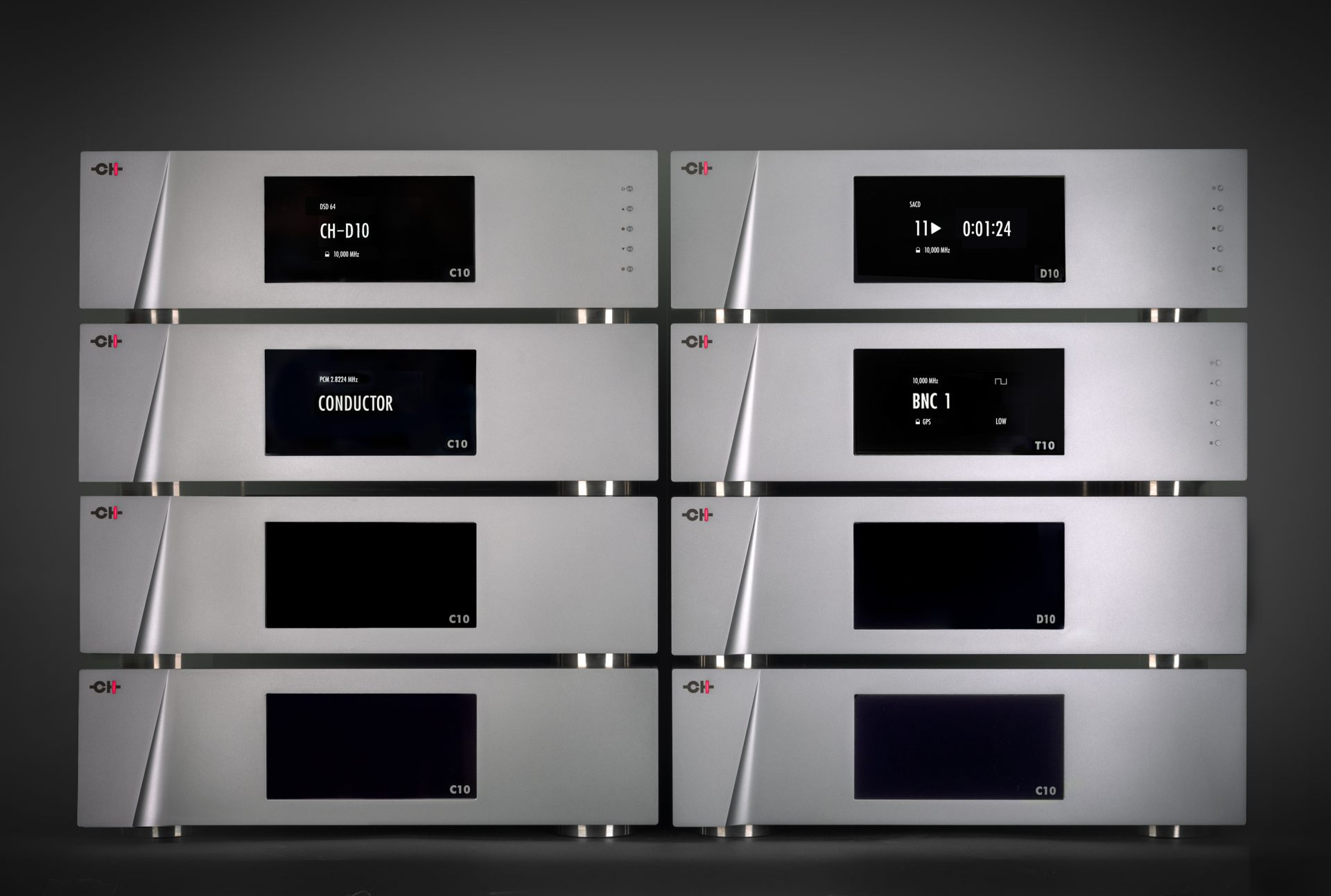
But what I can tell you now is, that for the first time, that IS a question. What I can also tell you is that there’s a lot of people who want to hear that comparison – and there won’t be many opportunities to do so. The chances of the Wadax Reference set-up and the eight-box CH happening to bump into each other and to do it on a level playing field, are vanishingly small. With that in mind, I’ll be bringing in some outside listeners and carefully noting and reporting their views with interest, so you won’t have to rely on my opinion alone. What I can also tell you is that the two systems sound quite different and, for me, the fascination lies in defining those differences and what they mean for the appeal of either system. Which is ‘best’ will remain in the ear of the individual listener, but finding that out is going to be as interesting as it’s going to be fun.