

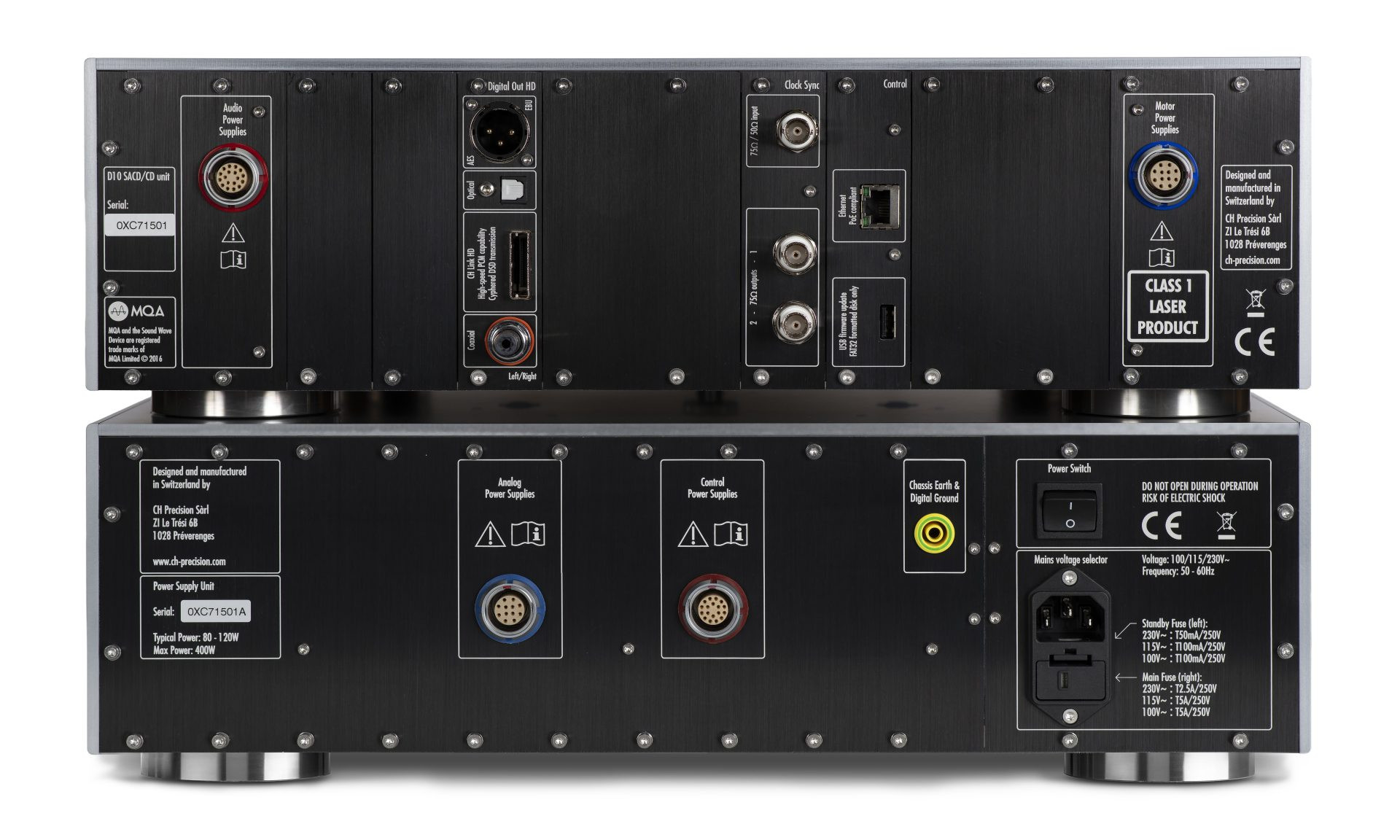
I have always argued that, in spite of the high asking prices, CH components actually represent a value-engineered solution. In a world where so many companies loudly (and stupidly) proclaim the “cost no object” nature of their products, CH has leveraged common chassis components and modular design to actually reduce build costs. If these products were built in a conventional fashion, they’d cost considerably more. In the same way, the company looks for cost-effective solutions to engineering challenges and the top-loading mechanism of the D10 is a case in point. You might think that the lid first elevates and then swings sideways. But look carefully and you’ll notice that it actually moves in a continuous arc, vertically at first, before smoothly transitioning to a lateral sweep. Why does that matter? Because it’s an operation that can be executed with a single motor, saving the cost, space and complexity of a twin-motor solution, one dedicated to vertical and the other to lateral movement. Of course, a ‘cookie jar’ lid, removed by hand, would be even cheaper to execute, but CH feel that their customers demand a certain elegance from their products: if you are going to take advantage of the mechanical benefits offered by a top-loading mechanism, don’t do so at the expense of corresponding ergonomic or operational compromises. Just like future proofing their products, the transport lid is an object lesson on matching expectation and practicality that underlines the company’s commitment to combining performance, quality and value. Talking of value, the D10 will cost you the considerable sum of €100,000 or $105,000. That’s approximately twice the price of a D1.5/X1 pairing, so the D10 needs to deliver – especially as the 1 Series set-up is sitting ready for direct comparison.
The C10 Reference DAC
Like the D10, the C10 DAC is a twin-chassis design and, like the transport there are a number of distinct physical and operational differences between it and the earlier C1.2. The first and in some ways most significant conceptual difference is that the C10 dispenses with the C1.2s control functionality: so, no variable output or analogue input/ADC options. This is a straight DAC, taking digital signals in and producing a fixed level, analogue output.
The second big difference between the C1.2 and the C10 is physical/topological. Where the C1.2 uses a linear layout, inputs on the right, outputs on the left as you look at the rear-panel, the C10 employs a mirror imaged layout, the analogue outputs (balanced XLR and single-ended RCA, together with channel specific signal and chassis grounds) flanking a central block of user selectable input modules and the same input/output clock board as the D10. It’s a layout that reflects the independent and galvanically isolated nature of the left and right channel DACs. But it also has a big impact on the C10’s extendable/expandable upgrade path and helps explain why the 10 Series steps away from the established C1.2 to C1.2 Mono nomenclature – even though the underlying upgrade path remains structurally the same, despite appearances. In a winning effort to combine cliché with audio’s bizarre semantics, the two-box C10 is referred to as the C10 Reference, while the upgraded, five-box DAC is termed the Statement Mono – but also includes The Conductor and the Master DAC! However, there is a tenuous logic in the slightly tortuous linguistics. Bear with me as I trace it through from the C1.2 upgrade path…