
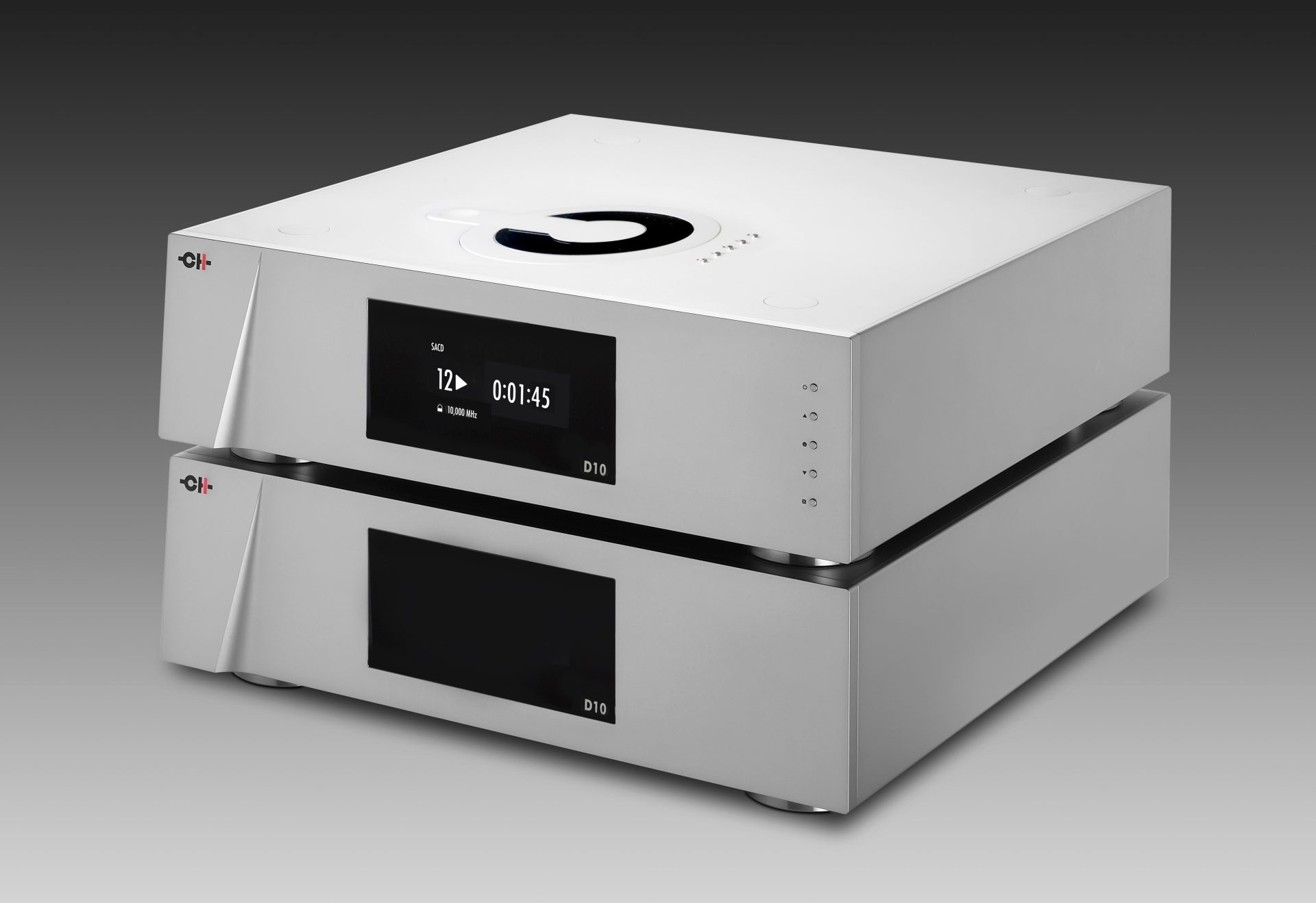
Unlike the D1.5, which can be configured with a range of different output modules to act as a transport or standalone player, the D10 is a dedicated transport, with no analogue output option. The output board is identical to the one used by the 1 Series digital components and offers the proprietary CH Link-HD connection, for native DSD transfer, alongside conventional AES/EBU, TosLink and S/PDIF outputs – the latter (somewhat incomprehensibly, on RCA rather than 75Ω BNC). You can add a second output board if you wish. Other than that, the unit’s rear panel features an input/output board (that allows you to configure system clocking topology or add an external clock like the T10) and a control module equipped with an RJ45 ethernet connection (to allow use of the CH Control App) and a USB socket for firmware updates. Neither of these is a streaming input.
The separate power supply unit is the same size as and slightly heavier than an X1, but unlike the 1 Series unit that can be paired with any two compatible 1 Series components (a P1/L1 or D1.5/C1.2 for example) it is a dedicated design that matches the D10 transport unit, carrying considerably greater smoothing capacitance and cascaded regulation. Colour coded umbilicals are provided to feed the highly-regulated DC to the different sections of the transport with the two umbilicals carry four discrete DC feeds. These power the reading mechanism, clock, lid mechanics and digital processing, ensuring that the ‘noisy’ motor elements cannot interfere with the fragile data stream generated by the optical head and its associated electronics.
Operationally, the D10 takes a little getting used to – at least for anybody familiar with other CH components. It has the same central AMOLED screen, with the same user-adjustable options as the D1.5 (colour, content, brightness, duration) flanked with those five, familiar push buttons on its right. But in the case of the D10, those buttons cover power and configuration options. The actual transport controls are on the top-plate, a second row of five buttons just to the right of the lift and swivel transport lid. I’ll admit, it took me a while to reprogramme my muscle memory to reach for the top-plate, rather than those tempting front-panel buttons.
The transport will play SACD, CD and MQA-CD discs, with PCM output data rates of 44.1 or 88.2kHz (redbook), DSD via CH Link-HD, to 2,8442MHz (scarletbook). Disc handling is excellent, despite the confines of the deep well in which the transport sits. Press the Open button and the lid elevates before pivoting anti-clockwise to the rear. Peripheral LED lights around the well illuminate so that you can see what you are doing, even in a darkened room. Press the Open button again and the transport lid reverses course to drop over the disc, the clamp on its underside engaging the transport spindle with a solid mechanical click. The LEDs actually brighten (considerably!) so that you can see the disc spinning up and being read through the darkened glass panels in the lid, before going out so as not to disturb the operation of the laser head during play.