
This phase-array DAC topology is an approach that demands huge processing power and exactingly executed algorithmic control. It is also – at least as far as I am aware – unique. But as we shall see, the results speak for themselves.
The T10 Time Reference 10MHz clock
The T10 is, in reality, simply a T1 in a 10 Series box, so that it will match the appearance of the flagship products. The price is identical, as is the performance and the facilities. That means that users get to connect as many as six external units, choose between square-wave and sign-wave outputs and have the option to lock the clock frequency to the atomic clock in a GPS satellite. It also means that I get to connect both the D1.5/C1.2 and the D10/C10 to the same t10 unit, thus saving myself a box, a power cord and a shelf in an exercise that’s straining the available real estate.
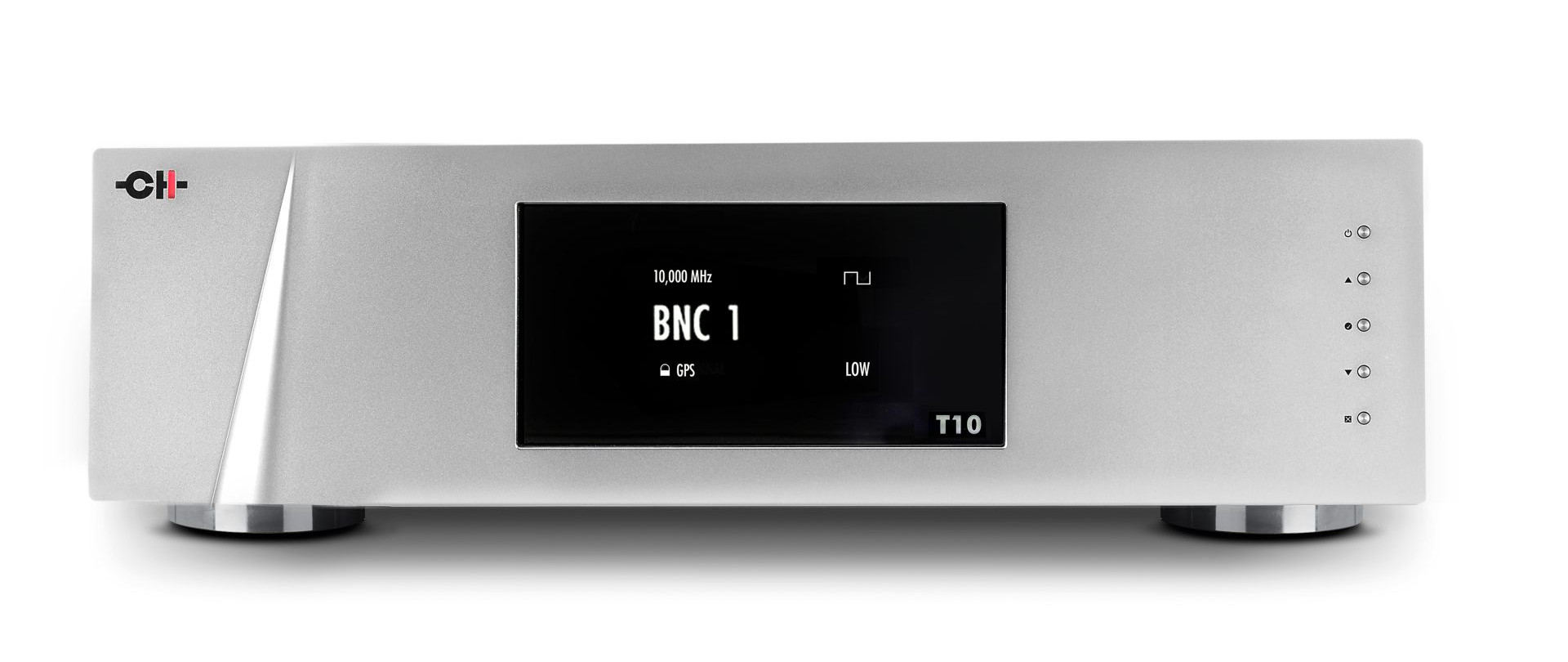
Of course, you can use the D10/C10 pairing without the external clock and the set-up menus allow you to configure clock priorities and routing accordingly, locking both units to a single internal clock. But even though the T10 might technically be considered an addition or upgrade on the base pairing, it’s a step that I suspect most D10/C10 listeners will take. For that reason, I’ve included it here rather than with the other Statement DAC steps. By the same logic, I’ll start by listening to its contribution to the D10/C10 set-up, before comparing that to the D1.5/C1.2/X1/T1 combination.
The review system…
Having established just what the T10 brings to the 10 Series digital party, the first (real) order of business is to assess how the D10/C10/T10 combination compares to the already impressive 1 Series, four-box rig. With that in mind, I listened to and compared the two CH digital set-ups in a carefully calibrated system designed to level the playing field and eliminate variables.
As already mentioned, both set-ups shared the same T10 clock and the same feed to their Streaming HD inputs. Both front-ends and the L10 pre-amp were supported on the Grand Prix Audio Monza rack, using Acouplex shelves and ReFract panels. The Acouplex damping plate is obviously incompatible with the D10 with its top-loading mechanism, so I listened to the D1.5 both with and without the ReFract in place. All of the CH units were equipped with and carefully levelled using the same titanium grounding spikes. Supplied as standard on the 10 Series, these are available as an extremely effective option for the 1 Series. Using them removed a significant variable, created consistency across both digital rigs (remember the shared T10) and the system as a whole. Besides which, I wanted to get the best possible performance from the 1 Series units. Amplification was either a pair of CH Precision M1.1s or M10s, while speakers were the Peak Consult El Diablos or the Göbel Divin Comtesse along with the Divin Sovereign sub-woofers. Cables were complete looms of either Nordost Odin 2 or Chord Music, with distribution via QB10s and a separate QB8 for the network components, with chassis grounding courtesy of Telos (the Master Earth Grounding unit) or CAD (a GCR for the amps and subs, a GC3 for the network). I used CAD USB controls on all of the CH firmware ports or USB inputs and none of the units were network connected for use with the Control App: I still prefer the consistency and reliability of manual control, especially in a review context. Nordost QK1s were used to ground the sovereign subs. The streaming input was disconnected unless it was being used. The 10 Series components were thoroughly run in (around 350 hours of constant, varied play-back) and then the whole system was left fully powered for the duration of the review. Let the games begin…
Adding the T10 Time Reference 10MHz clock…
Like all CH Precision digital products, the C10 and D10, offer the user a range of clocking options and priorities, accessed through the main menu. In the case of the C10, the clock parameters need to be set for each active input. This can be done via the front panel screen and controls or, more easily, via the CH Control App on a tablet. But what it does mean is that if you are going to start out listening to the D10 and C10 as a pair, you’ll need to establish how they’re going to talk to each other and who’s in charge.