Having run through the options (so you don’t have to) I far preferred using the internal clock on the D10 as the system master, running a clock cable from the Sync output on the transport to the Clock Sync input (the top BNC connector) on the rear of the C10’s clocking module. It also means setting the clock priority on the D10 to Internal and the appropriate CH Link-HD input on the C10 to Sync 75Ω. Believe me, it’s worth the effort. Using the DAC as the clock master produces an open, expansive but floaty sound. Reversing the priority brings not just significant substance but dynamic and temporal authority to the music, allowing you to really appreciate the body, presence, natural dynamic and rhythmic coherence and sense of musical purpose that are the hallmarks of the D10/C10. Even as a straight four-box set-up, the 10 Series digital components have a sense of stability, solidity and musical authority that is almost unheard of from digital sources.
Playing Isabel Faust’s recent Locatelli disc (il virtuoso, il poeta, with Antonini and Il Giardino Armonico, Harmonia Mundi HMM 902398) the D10/C10 really capture the concentration, technique and virtuosity in her playing, the focussed energy and intensity in the small group accompaniment, the organic quality in the performance as a whole. These pieces might have been written to display the skills of the soloist: they do a fantastic job of showing off the attributes of the replay platform.
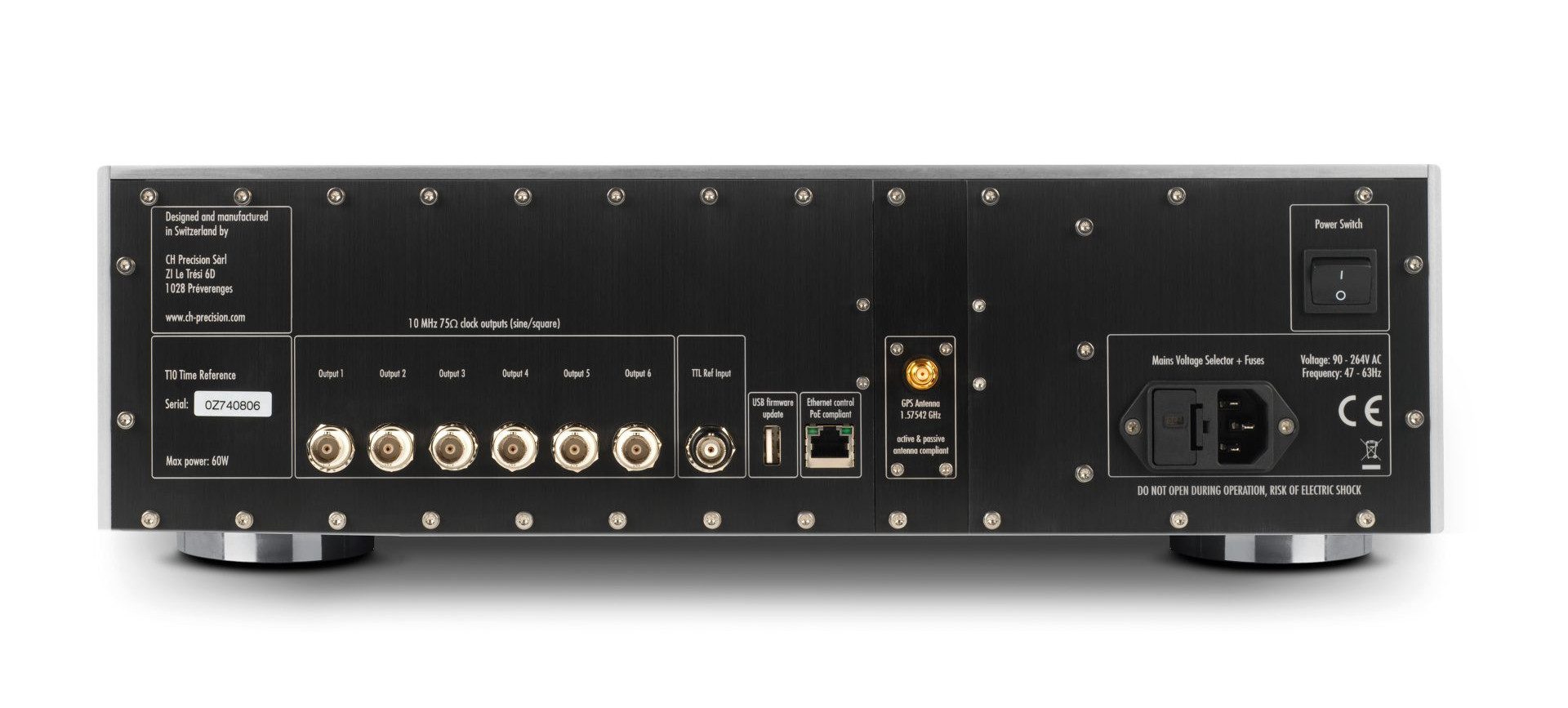
Which rather begs the question, what does the T10 add to the musical equation? Connecting the C10 and D10 to the T10 clock requires re-setting both of their clock priorities to 75Ω Sync and attaching the clock cables between the clock’s BNC sockets and the top, Clock Sync sockets on the rear of both audio units. With that done, make sure that the T10’s output waveform is set to Square Wave (the sign wave output is to allow the clock to lock with units whose clock frequencies exhibit drift or an inaccurate frequency) the output level is set to Low and that the unit itself is up to temperature and stable – a critical concern when it comes to clock accuracy. With those things taken care of – along with the GPS lock if you are using the optional GPS antenna – you are ready to listen.
The first thing you are going to notice is the way that musical energy seems more focussed and concentrated. Notes are more clearly spaced, the spaces between the more clearly defined. The note to note relationships within phrases are much more articulate, the shape and placement of phrase more apparent. The overall pace and tempo of a track is not just more obvious, it also has a natural, expressive quality. These may not be large differences in quantitative terms: indeed, you could argue that with the T10 feeding the D10 and C10, the more localised energy they project adds up to less – certainly a less diffuse spread of sound. The clock stops the energy bleeding into and filling the spaces between notes, making those notes clearer, more prominent, their shape and energy envelope more audible and convincing. That precision when it comes to notes starting, stopping and the spaces between them, helps define pace and tempo, musical flow and momentum. So, qualitatively, the clock makes the music more convincing, more engaging, more intelligible, more expressive and ultimately, more believable.